Airport Security 3D: Screen Passengers and Catch Contraband
What You're Actually Doing
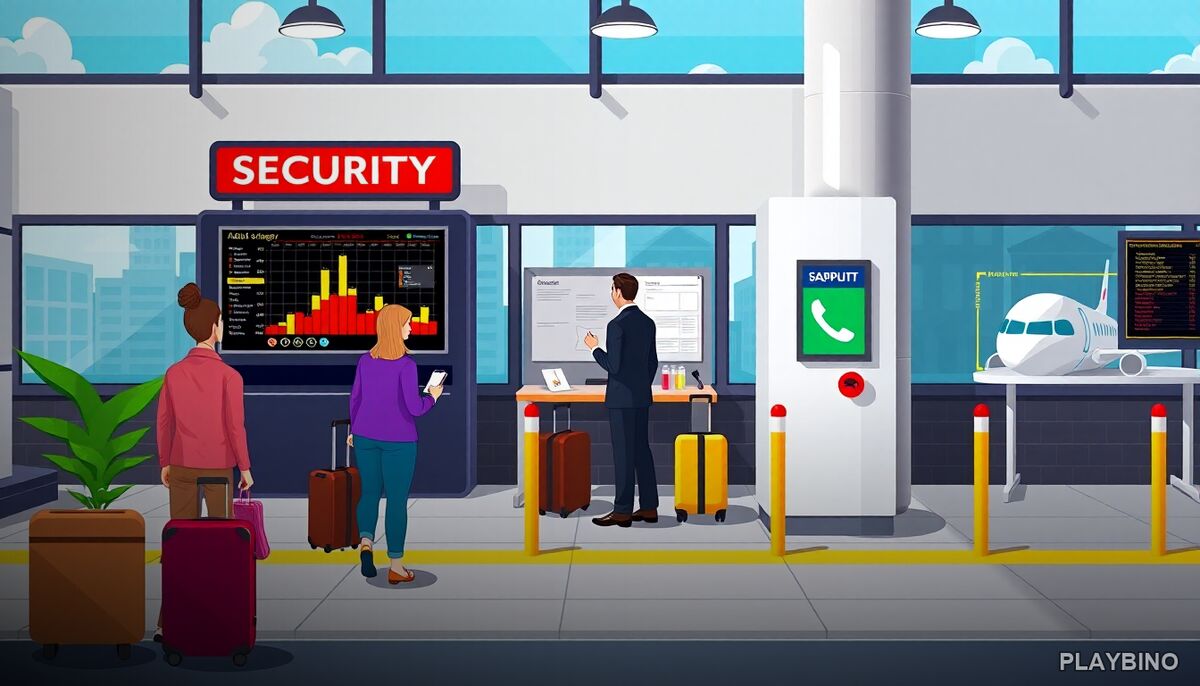
Most airport games put you in the cockpit. This one puts you at the checkpoint, which is a completely different kind of pressure. This browser simulation tasks you with screening passengers one by one, checking their documents, scanning their bags, and deciding who gets through. The cartoon visuals soften the tone, but the logic underneath is genuinely demanding.
Each shift brings a queue of passengers, each with their own luggage, ID, and boarding pass. Your job is to cross-reference everything. A name that doesn't match, a prohibited item buried in a suitcase, a suspicious object on the scanner — any of these can mean the difference between clearing someone and flagging them for further inspection.
The Screening Mechanics
The core loop involves two main checks: document verification and luggage scanning.
Document Checks
You'll compare identification against boarding passes. Dates, names, and document formats all matter. Forged or inconsistent paperwork is easy to miss if you're rushing, and the game doesn't always make the discrepancy obvious. You have to slow down and actually read what's in front of you.
Luggage Scanning
Bags pass through an X-ray-style scanner, and you need to identify prohibited items hidden among ordinary belongings. Concealed weapons and restricted objects can be tucked between clothing and personal items. The visual puzzle here is real — the scanner view requires you to mentally parse overlapping shapes and recognize outlines that don't belong.
What Makes It Challenging
The difficulty doesn't come from fast reflexes. It comes from sustained attention. Missing a fake passport or letting a concealed item through counts as a failure. As you progress, the terminals get busier, the passengers come faster, and the documents get more complex. The game is essentially a logic and observation test dressed up as a simulation.
- Passenger documents must match across multiple fields
- Prohibited items are visually disguised within normal luggage
- Suspicious behavior adds another layer to evaluate
- Accuracy is tracked — repeated errors end your shift early
- Later levels introduce more passengers per round
Strategy for Getting Further
The players who advance furthest are the ones who build a consistent checking routine. Rather than scanning randomly, develop a fixed order: check the ID first, then the boarding pass, then run the bag. Doing this the same way every time reduces the chance of skipping a step when the queue starts to pile up.
When the scanner shows a cluttered bag, don't rush to clear it. Rotate your mental image of the contents and look for shapes that stand out. A weapon outline doesn't disappear just because it's surrounded by clothes. If something looks off, it probably is.
Who This Game Suits
If you enjoy puzzle games that reward careful observation over speed, this simulation fits naturally into that category. It's a single-player brain game built around logic and pattern recognition rather than action. Players who like hidden object games or document-checking puzzles will find familiar satisfaction here, but the airport setting gives it a distinct procedural feel that keeps it from feeling like a standard puzzle format.
For something with a completely different physical challenge, the Bottle Battle experience on PlayBino takes a much more arcade-focused approach if you want to switch gears between sessions.
Progression and Replayability
Each completed shift unlocks a more demanding terminal. The passenger volume increases, documents become trickier to verify, and the scanner becomes harder to read cleanly. There's no freeform sandbox here — the game pushes you forward through structured levels, which means each session has a clear goal and a measurable outcome. That structure keeps the challenge feeling purposeful rather than random.
"