Basket Ball: Aim, Time, and Score Through Every Obstacle
What Kind of Game Is This?
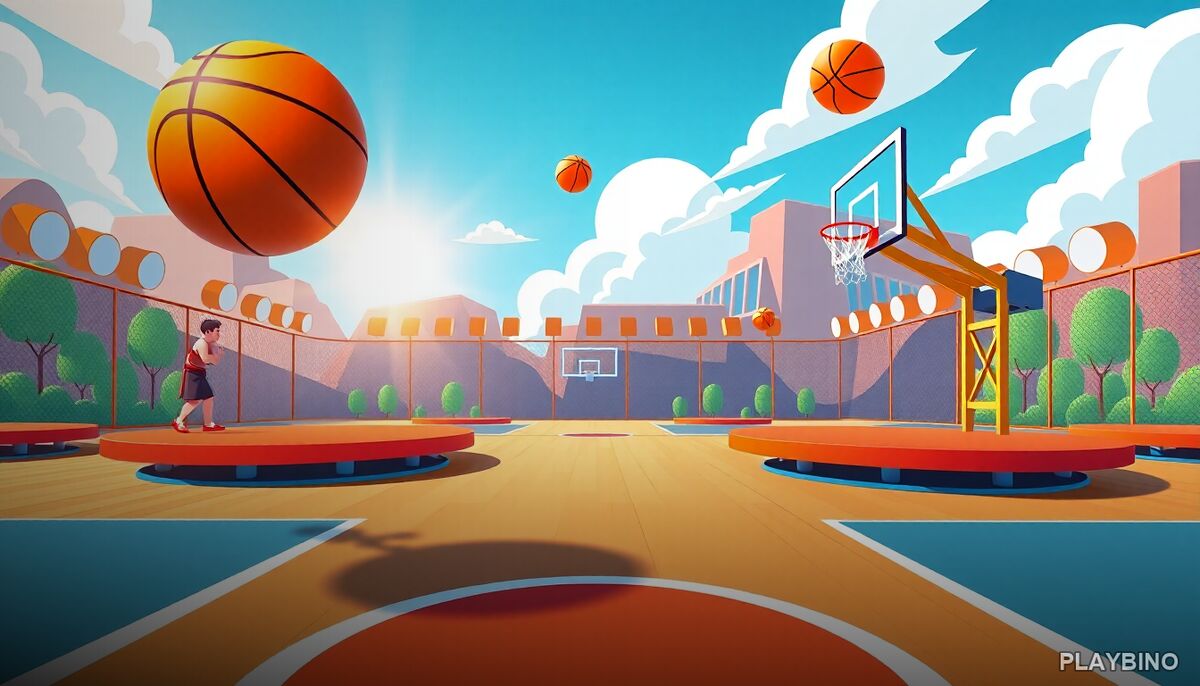
Basket Ball sits at the intersection of puzzle thinking and physical skill. Each level presents a small court built on platforms, with red obstacles moving across the play area and a hoop waiting at some angle you need to figure out. The challenge is not just hitting the basket — it is hitting it at the right moment, from the right position, with the right amount of power. Try the full challenge and you will quickly see how much thought goes into each shot.
How the Shooting Mechanics Work
The core interaction is simple: you aim and release. But the physics underneath reward careful attention. Trajectories arc naturally, and the ball responds consistently to the angle and force you apply. That predictability is actually the game's strongest quality — it means failure always teaches you something. If a shot falls short, you know to add more power. If it clips the rim, you know to adjust the angle slightly. Over time, you build a mental map of how the ball behaves.
Reading the Arc
One of the first things to practice is judging the arc before you release. Shots that go too flat tend to bounce off obstacles rather than pass cleanly above them. A higher arc gives the ball more vertical drop into the hoop, which is often the safer approach when platforms are close together.
Power and Distance
Distance between your position and the basket changes how much power you need. On wider courts, holding longer increases range but also makes the shot harder to control. On tighter layouts, small adjustments matter more than raw force.
The Role of Red Obstacles
The spinning red hazards are not just decoration. They patrol specific paths and force you to make a real decision on every shot: wait for a clear window, or attempt a riskier angle while the obstacle is partially out of the way. Early levels give you generous gaps. Later levels shrink those windows considerably, and sometimes two obstacles are moving in overlapping patterns that require you to time both simultaneously.
Patience is a genuine skill here. Rushing a shot because the hoop is right there usually ends with the ball deflected and the attempt wasted. Learning to hold back and wait for alignment is what separates clean runs from frustrating ones.
Platform Layout and Level Progression
As the game advances, the courts stop being flat and predictable. Platforms shift position mid-level, which means your shooting angle can change between attempts. What worked for the first shot may not work for the second if the surface beneath you has moved. This adds a layer of spatial awareness on top of the shooting skill itself.
- Early levels: fixed platforms, slow obstacles, wide hoops
- Mid levels: slight platform movement, faster obstacle rotation
- Late levels: shifting surfaces, overlapping hazard patterns, tighter margins
The progression feels honest. Nothing is introduced without warning, and the difficulty curve gives you enough time to internalize each new mechanic before it gets harder.
Strategy That Actually Helps
A few habits make a noticeable difference across levels. First, always observe the obstacle pattern for a full cycle before attempting a shot — most hazards repeat on a fixed loop, and knowing that loop removes the guesswork. Second, position yourself deliberately rather than shooting from wherever you land. Some platforms offer better angles than others, and moving to a better spot first is often worth the extra second. Third, do not treat every attempt as a race. The game does not penalize waiting, so use that freedom.
Bare Ball is another browser game built around similar ball-physics mechanics — that one takes a different approach to the concept if you want to compare how two games handle the same basic idea differently.
Who This Game Suits
Anyone who enjoys single-player puzzle games with a physical skill component will find this satisfying. The one-player format means no pressure from opponents — just you, the hoop, and the problem in front of you. PlayBino hosts the game directly in the browser with no installation needed, which makes it easy to pick up between other things. If you like games where improvement comes from observation and repetition rather than reflexes alone, Basket Ball delivers that loop consistently across its levels.
"