Bounce Ball Timer: Precision, Timing, and Three-Star Challenges
What Kind of Game Is This?
Bounce Ball Timer sits at the crossroads of arcade reflex games and spatial puzzle challenges. Each level presents a confined space filled with barriers, moving hazards, and three stars positioned to make your life difficult. Your job is simple to describe but genuinely hard to execute: get the ball to collect all three stars without hitting something it shouldn't. The full browser version runs without downloads, so you can jump straight into the first level and feel out the mechanics immediately.
How the Bouncing Mechanic Works
The ball doesn't move in a straight line or follow simple physics. It bounces, curves, and reacts to the environment in ways that take a few attempts to internalize. Timing your inputs around the bounce rhythm is the central skill here. Hit a wall at the wrong moment and you miss a star entirely. Hit it right and the ball arcs cleanly through a gap you weren't sure existed.
Reading the Level Layout
Before attempting a stage, it helps to pause and scan the obstacle arrangement. Star placement is rarely accidental — the designers position them to force you through specific paths. Recognizing those intended routes early saves a lot of repeated attempts.
Hazards and Barriers
Obstacles range from static walls to moving blockers that shift on a fixed cycle. The moving ones require you to match your bounce timing to their pattern, which adds a rhythm-game quality to certain stages. Missing the window means restarting, but the levels are short enough that repetition doesn't feel punishing.
Star Collection Strategy
Collecting all three stars in a single run is the core objective, but the order you collect them in matters. Some stars are positioned so that grabbing one early closes off the path to another. The puzzle element comes from figuring out the correct sequence before committing to a full run.
- Identify which star requires the most precise timing and plan your approach around it.
- Look for stars that sit along the same natural bounce path and chain them together.
- If a moving hazard guards a star, watch its cycle two or three times before attempting.
- Mistakes reset the stage quickly, so use failed runs as information rather than frustration.
Progression and Difficulty Curve
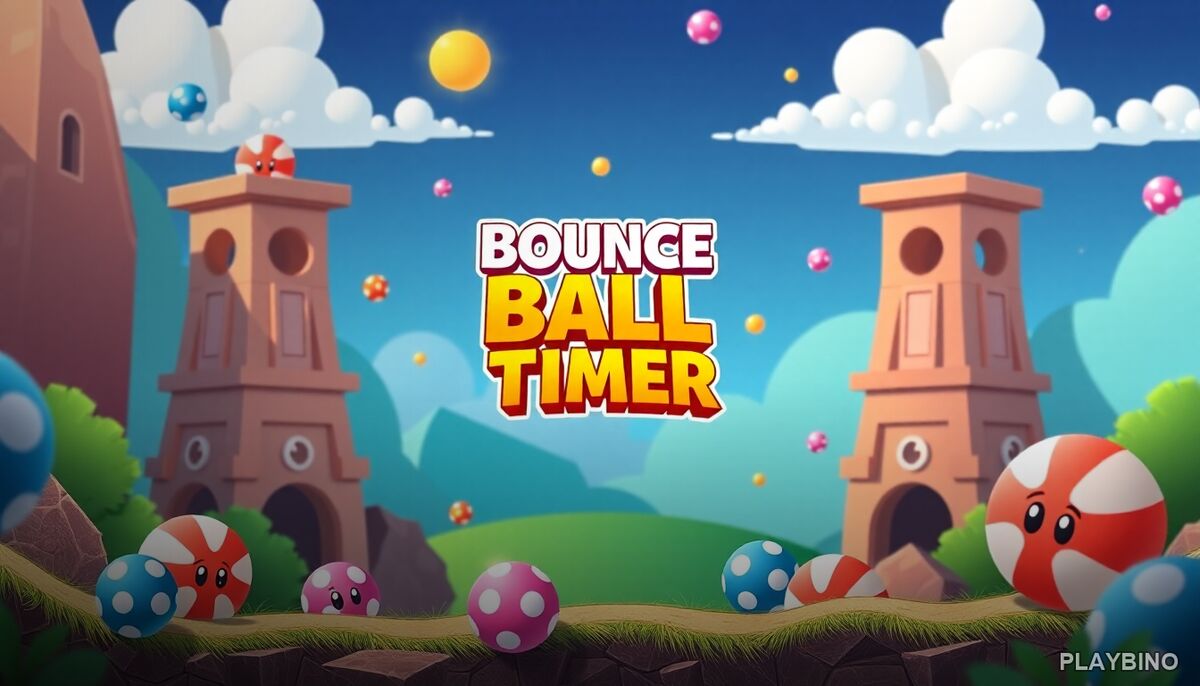
Early stages introduce the bounce mechanic with generous spacing and simple layouts. The difficulty ramps gradually, adding more obstacles per stage and placing stars in positions that demand tighter control. By the mid-game, you're dealing with layered hazard patterns and stars tucked into corners that require near-perfect entry angles. The colorful visual design keeps the experience light despite the increasing challenge, which helps maintain focus without adding visual stress.
Who This Game Suits
Bounce Ball Timer works well for players who enjoy short, repeatable arcade challenges where improvement comes from observation rather than luck. It's the kind of game where a level that seemed impossible on the third attempt becomes straightforward on the seventh, because you've learned its rhythm. If you also enjoy physics-driven puzzle games with a similar pick-up-and-play structure, Boxes Funny offers a comparable experience worth exploring on PlayBino.
Controls and Feel
The input system is minimal, which is intentional. Fewer controls mean the challenge lives entirely in timing and spatial awareness rather than complex button combinations. The ball responds consistently, so when a run goes wrong, the cause is always readable. That consistency is what makes repeated attempts feel fair rather than arbitrary, and it's what keeps the skill-based loop engaging across multiple stages.
"