Candy Shuffle: Match-3 Strategy and Combo Guide
What Kind of Game Is This?
Candy Shuffle is a match-3 puzzle game built around swapping colorful candies on a grid to form lines of three or more identical pieces. It follows the classic format most puzzle fans recognize instantly, but layers in cascading chain reactions, special candy effects, and level-specific objectives that push the strategy side of things further than a simple color-matching game. Play it directly in your browser and you'll notice the board reacts quickly, keeping the pace snappy while still rewarding careful planning.
How the Matching Mechanic Works
The core action is simple: select a candy and swap it with an adjacent one to complete a row or column of three or more matching pieces. When a match clears, the candies above fall into the gaps, and if those falling pieces happen to align into new matches, a cascade begins. These chain reactions are where the big scores come from, and learning to predict them is what separates a careful player from someone just moving pieces at random.
Special Candies
Matching four or more candies in a single move creates a special candy with a more powerful clearing effect. A line of four typically produces a striped candy that wipes out an entire row or column. Matching five in an L or T shape, or five in a straight line, generates even stronger effects. Activating two special candies together can clear large sections of the board at once, which becomes essential in later levels where move counts are tight.
Cascade Logic
The cascade system means every move has potential beyond what you see immediately. A match in the middle of the board can shift pieces in unexpected ways, setting up combos you didn't plan. Experienced players start reading the board two or three moves ahead, looking not just at what matches now but at what will fall into place afterward.
Level Structure and Difficulty
Early levels introduce the basics without much pressure. Objectives are straightforward, move limits are generous, and the board layouts are open. As you progress, the game introduces obstacles, restricted grid shapes, locked tiles, and targets that require clearing specific candy types or reaching point thresholds. The difficulty curve is gradual but consistent — levels that felt easy in the first dozen stages become noticeably harder once the board starts filling with blockers and the move count drops.
Strategic Thinking Over Luck
Candy Shuffle leans toward strategy more than chance. While the candy layout has a random element, the decisions you make with each move matter significantly. Wasting moves on low-value matches when a better setup is two moves away is a common mistake. A few principles that help:
- Work from the bottom of the board when possible — matches lower down cause more cascades as pieces fall.
- Prioritize building special candies over clearing single matches whenever the objective allows it.
- Save special candy combos for moments when the board is congested rather than using them the instant they appear.
- Watch the move counter carefully in levels with limited moves and avoid spending early moves on non-essential targets.
Visual Style and Feel
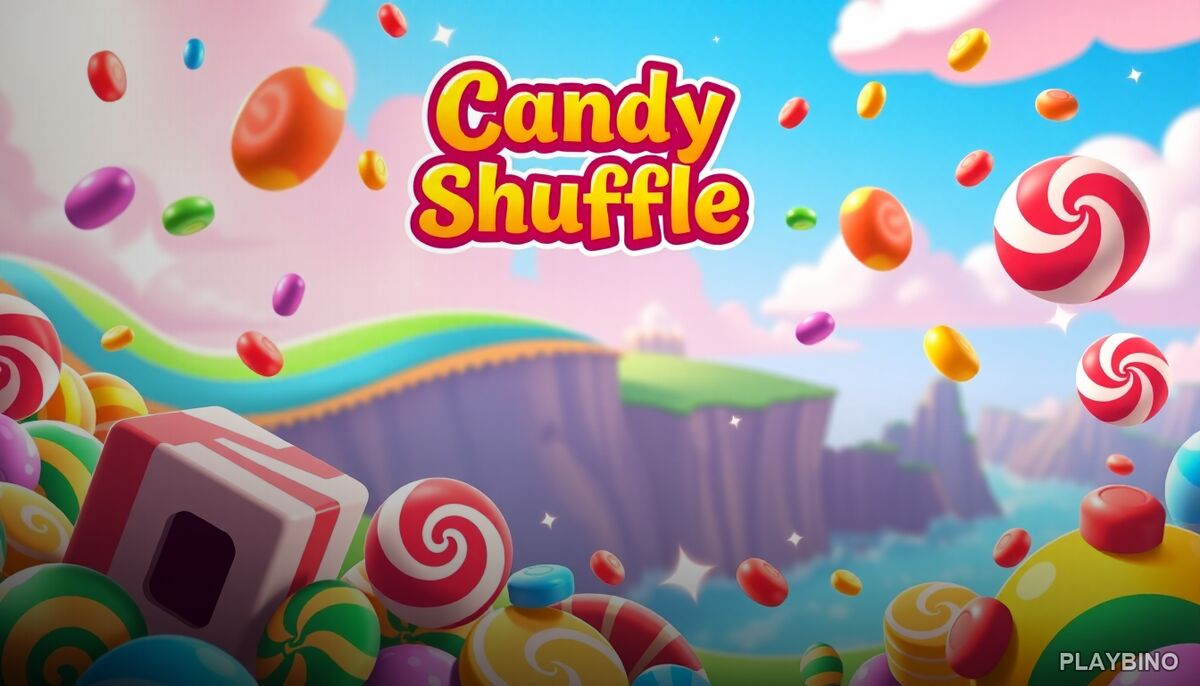
The game uses bright, saturated candy colors with smooth animations that make each match satisfying to watch. Cascade chains have a pleasing visual flow, and the special candy explosions are clear enough to read without being overwhelming. The interface stays clean, keeping the focus on the board rather than cluttering the screen with unnecessary elements. It's a polished presentation that suits the puzzle format well.
Similar Puzzle Game to Try
Fruit Candy Merge takes a different approach to candy-based puzzles — instead of swapping pieces on a grid, it uses a merging mechanic where combining matching items creates progressively larger ones. If the match-3 format interests you but you want to see how another candy-themed puzzle handles its core loop, that game has its own distinct challenge worth exploring. Both titles are available on PlayBino and offer a good contrast in how puzzle mechanics can be built around a similar theme.
"