Cute Animal Rotate Puzzle: Brain Teaser With Charming Animal Art
What Kind of Puzzle Is This?
Tile rotation puzzles occupy a satisfying middle ground between casual play and genuine mental challenge. Cute Animal Rotate Puzzle leans into that space with bright animal illustrations split across a grid, where every piece needs to be spun into the right orientation before the full image snaps together. Play it directly in your browser and you'll notice immediately how clean and approachable the presentation feels — no timers screaming at you, no lives draining away.
The core mechanic is simple: tap or click a tile to rotate it. The goal is to align every piece so the animal portrait looks complete and unbroken. Simple in concept, but the moment you think a section looks right and then realize one corner tile is still off by 90 degrees, the puzzle pulls you back in.
How the Rotation Mechanic Works
Each tile rotates in fixed increments — typically 90 degrees per click. There's no dragging or swapping involved, which keeps the focus entirely on orientation rather than positioning. That distinction matters. You're not trying to figure out where a piece belongs on the grid; you already know its location. The challenge is purely about reading the image fragment on each tile and deciding which way it should face.
Reading the Visual Clues
The key skill here is learning to read partial shapes. A curved line on one tile might be the ear of a rabbit or the tail of a cat — and without context from neighboring pieces, it can be genuinely ambiguous. Working outward from a corner or a high-contrast area of the image tends to be more effective than trying to solve the middle of the grid first.
When One Tile Changes Everything
One of the most satisfying moments in this type of brain puzzle is the cascade effect — fixing one stubborn tile suddenly makes three neighboring pieces click into place visually. That moment of recognition, where a blurry mess resolves into a smiling animal face, is exactly what keeps players coming back for another round.
Difficulty and Progression
The challenge scales gradually. Early puzzles use smaller grids with bolder, easier-to-read artwork. As the levels progress, the grid expands and the animal illustrations become more detailed, meaning individual tiles carry less obvious visual information. A tile from the background of a forest scene is much harder to orient correctly than a tile showing a distinctive patch of fur or a bright eye.
This gradual curve means the game never feels overwhelming early on, but it does demand more careful observation as you advance. Rushing through rotations without studying each tile carefully leads to a board that looks almost right but is subtly wrong — which is arguably more frustrating than a completely scrambled grid.
The Visual and Audio Atmosphere
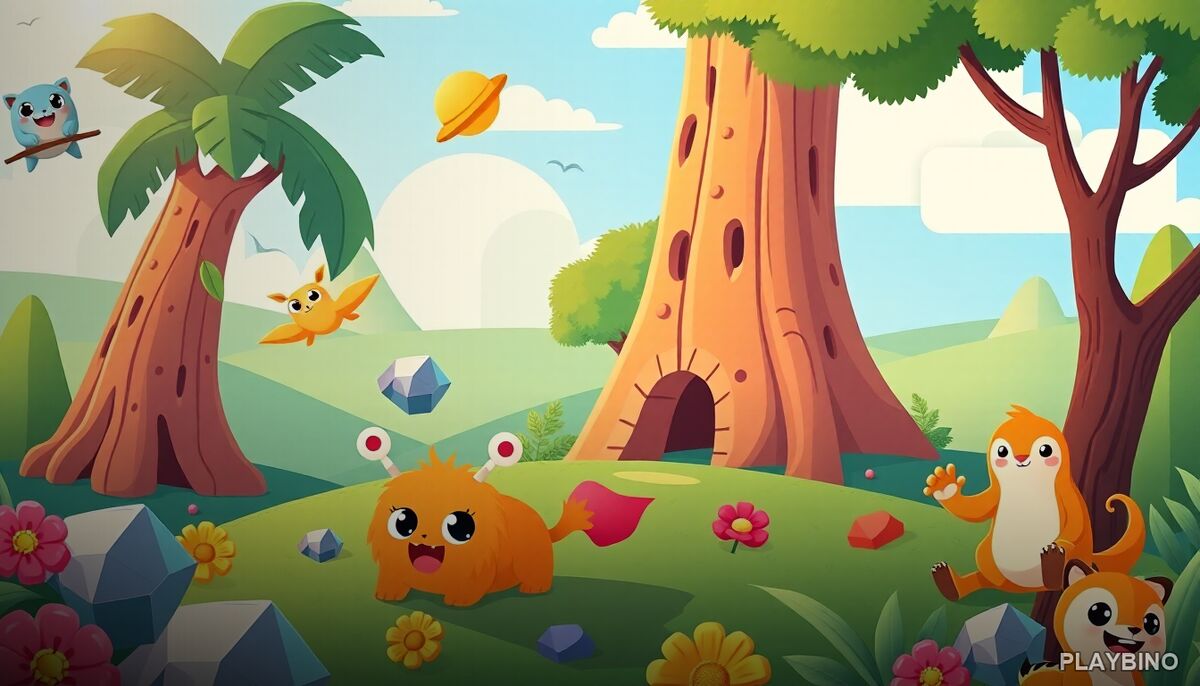
The artwork style is deliberately cheerful. Animals are rendered with rounded shapes, saturated colors, and expressive faces — the kind of illustration style that feels inviting rather than competitive. Smooth rotation animations give each tile click a satisfying physical quality, and the overall pace of the game encourages a calm, methodical approach rather than quick reflexes.
This makes Cute Animal Rotate Puzzle a good fit for short breaks or winding down after something more intense. The brain engagement is real, but the atmosphere never feels stressful.
Similar Puzzle Experiences to Explore
If image-based puzzles appeal to you, Easter Pic Slider offers a different take on picture reconstruction — this time using sliding mechanics instead of rotation, with festive seasonal artwork. Both games share the same satisfaction of restoring a scattered image into something whole, but the mechanical approach is distinct enough to feel fresh.
PlayBino hosts both titles alongside a wide range of other brain and puzzle games, making it easy to move between different styles of visual challenge without leaving the browser.
Who This Game Suits Best
- Players who enjoy calm, observation-based puzzles without time pressure
- Anyone who likes completing images or jigsaw-style challenges
- Casual gamers looking for a short mental reset between tasks
- Puzzle fans who prefer logic and pattern recognition over reflex-based gameplay
The game doesn't demand long sessions. A single puzzle can take anywhere from two minutes to ten depending on grid size and difficulty, which makes it easy to pick up and put down without losing progress or momentum.