Food Blocks Puzzle: Grid Strategy and Line-Clearing Logic
What Kind of Game Is This?
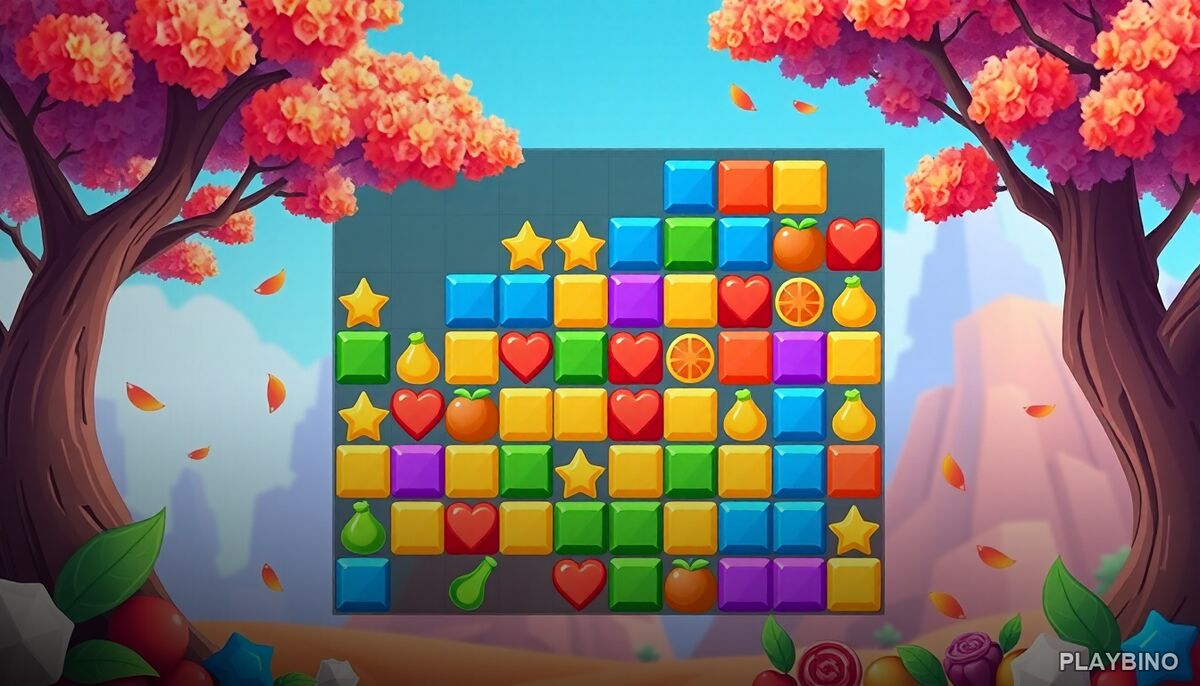
Food Blocks Puzzle sits at the intersection of spatial logic and match-3 thinking. Instead of swapping tiles or matching colors, you're placing irregularly shaped pieces onto a square grid and trying to clear complete rows or columns before the board fills up. The food-themed visuals — think colorful slices, treats, and snack shapes — give it a playful look, but the underlying mechanics are firmly rooted in puzzle logic and pattern recognition.
Each turn deals you three block shapes. You place them one at a time, and the order matters. There's no rotating pieces, no undo button. Once a block lands, it stays. The full challenge comes from deciding not just where each piece fits right now, but how that placement affects the next two or three moves.
How the Grid Works
The board is a fixed square grid. Blocks occupy multiple cells, and when an entire row or column is filled with no gaps, it clears and frees up that space. Clearing multiple lines at once is more efficient and keeps the board open longer. The longer you keep open lanes across the grid, the more flexibility you have when awkward shapes arrive.
Line Clearing vs. Survival
Early in a session, it's tempting to cluster pieces together and clear lines quickly. That works for a while, but it can fragment the remaining open space into disconnected pockets that are hard to fill with later pieces. The smarter approach is to think of the board in zones — keeping at least one or two clear corridors that can absorb long or L-shaped blocks.
Dealing With Awkward Shapes
Some of the food-shaped pieces are compact and easy to slot in almost anywhere. Others are wide, tall, or oddly notched. When an awkward shape appears, scan the board for any existing gap that matches its footprint before defaulting to open space. Fitting a piece into a pre-existing hole is almost always better than starting a new cluster in a clean area.
Scoring and Progression
Points accumulate with every block placed and spike when lines clear. Clearing two or more lines simultaneously gives a bigger score bump, which rewards players who set up multi-line clears rather than clearing one line at a time. There's no timer, so the pressure is entirely spatial — the game ends when none of the three current pieces can fit anywhere on the board.
Strategic Habits That Help
- Prioritize placements that complete or nearly complete a row or column rather than filling random gaps.
- Avoid pushing pieces into corners unless they genuinely fit a corner-shaped gap.
- When two of the three pieces are easy to place, use the third to set up a future clear rather than just filling space.
- Keep the center of the board as open as possible in the early game — corner and edge cells are harder to clear efficiently.
- Scan all three pieces before placing any of them