Free Fly: Endless Arcade Flying with a Bee
What Free Fly Is About
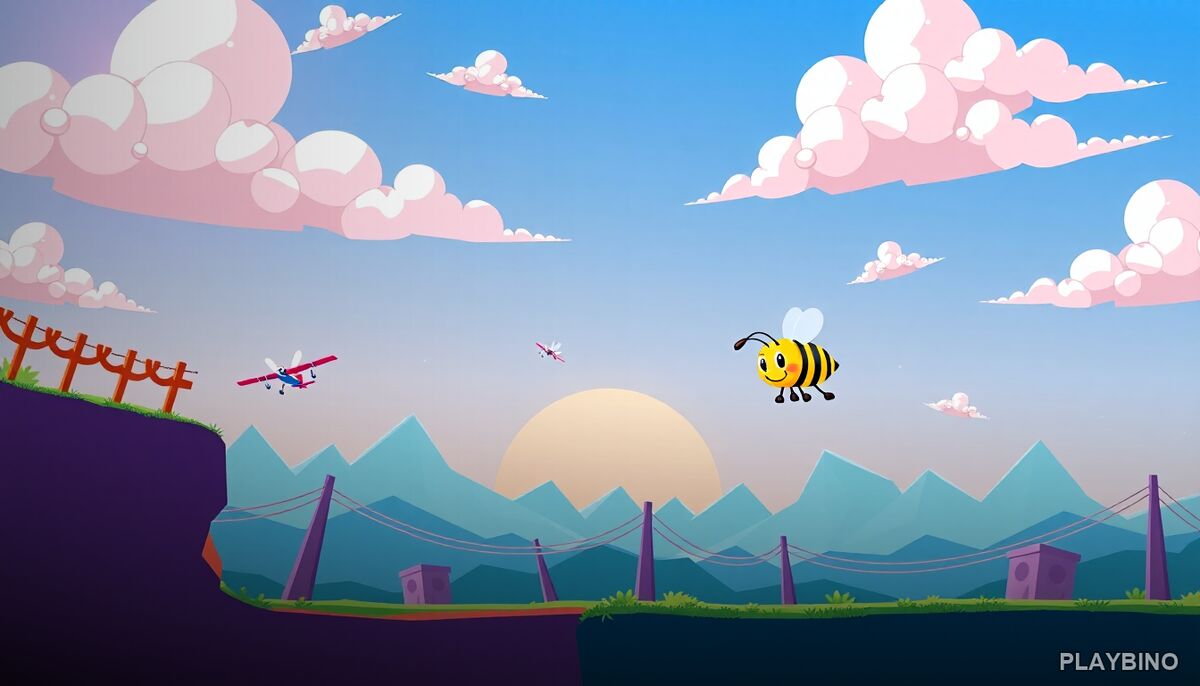
A small bee. An endless sky. Clouds drifting in from every direction. Free Fly strips arcade gameplay down to its simplest form and then asks you to survive as long as possible. Each run starts the same way, but the path upward never repeats itself. The obstacles shift, the rhythm changes, and the pressure builds the longer you stay airborne.
If you want to jump straight in, try this endless arcade climb on PlayBino and see how high your first run takes you.
The Core Mechanic
The entire game runs on a single input. Each tap on the screen lifts the bee upward. Release the tap and it begins to descend. That push-and-pull between rising and falling is the foundation of every decision you make.
What makes it genuinely difficult is that the bee responds immediately to every tap. There is no momentum buffer or forgiveness window. Tap too fast and the bee shoots upward into a cloud. Wait too long and it drops below a safe line. Maintaining a steady altitude requires a consistent internal rhythm, and that rhythm gets harder to hold as clouds appear more frequently during longer sessions.
Timing Over Speed
New players often tap too aggressively, trying to stay high at all times. The smarter approach is to find a middle altitude and make small corrections rather than large swings. Short, measured taps give you more control than rapid bursts. The bee responds to precision, not panic.
Honeycomb Scoring
Survival alone is not the only goal. Honeycombs are scattered throughout the ascent, and collecting them adds points to your score. They give each run a secondary objective beyond simply avoiding clouds. Chasing a honeycomb that sits near an obstacle is a calculated risk, and deciding whether to go for it or play it safe becomes one of the more interesting micro-decisions in the game.
Over time, your score reflects both how long you survived and how many honeycombs you collected along the way. A cautious run might last longer but score lower than a riskier one where you grabbed every pickup in reach.
How the Visual Progression Feels
The backdrop shifts as you climb higher. Early sections have a bright, open sky feel. Further up, the color palette changes and the environment takes on a different tone. It is a small detail, but it gives the sense that altitude actually means something. You are not just looping through the same screen repeatedly. The visual change acts as informal feedback that your run is going well.
Obstacle Patterns
Clouds do not follow a fixed schedule. They drift in at unpredictable intervals, which means pattern memorization is not a useful strategy here. Reading what is coming in real time and reacting quickly is what separates longer runs from shorter ones. The randomness keeps each session feeling distinct even though the core mechanic never changes.
Who This Game Suits
Free Fly works well for players who enjoy one-more-run arcade loops. The sessions are short enough that a failed run never feels like a major setback, but the personal score target keeps pulling you back. It fits the endless runner format closely: no story, no levels, just a climbing score and the challenge of beating your own best.
- Single tap control with immediate response
- Honeycomb collectibles for bonus scoring
- Randomized cloud obstacles that prevent pattern memorization
- Shifting visual backdrop tied to altitude
- No endpoint — improvement is the goal
Players who enjoy similar flying and obstacle-dodge mechanics might also find value in another airborne arcade challenge worth exploring.
Building a Better Run
The gap between a short run and a long one usually comes down to composure. Players who stay calm and make small tap adjustments consistently outperform those who react with large corrections. When a cloud appears suddenly, the instinct is to tap hard and rise fast. That instinct is usually wrong. A gentle tap and a slight lateral adjustment often clears the obstacle more reliably.
Tracking your personal best score gives the game its long-term pull. There is no external reward system or unlock progression. The motivation is entirely internal, which suits the endless runner format well. Each session is a clean attempt at doing better than the last one.
"