Frisbee 3D: Precision Throwing Through Rings and Obstacles
What Frisbee 3D Is About
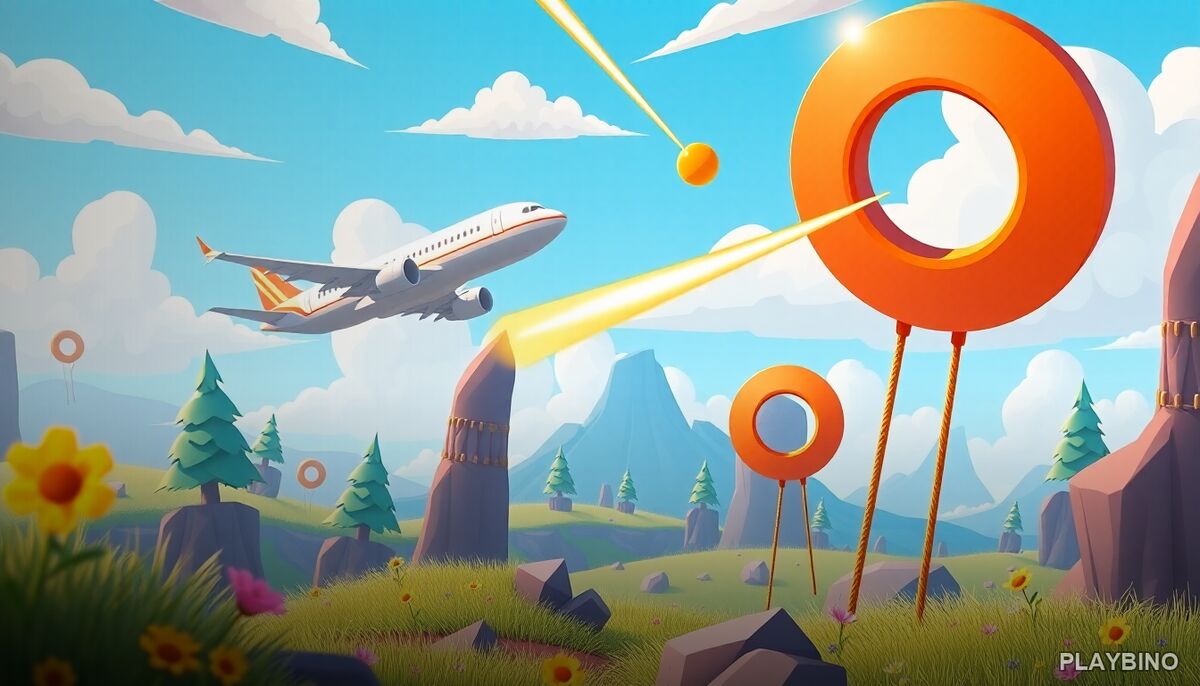
Most browser skill games keep things flat. Frisbee 3D takes a different approach by putting your disc in a fully spatial environment where depth, angle, and timing all matter at once. You launch a frisbee from a fixed position and guide it through a series of floating rings before landing it cleanly in a basket at the end of the course. Miss a ring or clip an obstacle, and the level resets. No checkpoints, no partial credit.
The game builds its challenge around reading the path ahead before you throw. Each course lays out rings, trees, barriers, and other hazards in formations that require you to visualize the full arc of your disc before committing. This aerial precision challenge rewards patience and spatial thinking more than raw reaction speed.
Throwing Mechanics and Trajectory
The core mechanic is deceptively simple: aim, adjust, and release. But the 3D perspective adds a layer of complexity that flat throwing games avoid. You need to account for horizontal angle, vertical lift, and the curve the disc takes mid-flight. The frisbee does not travel in a straight line, and that drift is both the main obstacle and the main tool.
Reading the Course
Before each throw, scan the full layout. Rings are positioned at different heights and lateral positions, so a throw that clears the first ring might be too high or too wide for the second. The course design forces you to think about the entire sequence, not just the next gate.
Adjusting Mid-Flight
Some levels allow limited adjustment after release, which adds another decision layer. Knowing when to correct and when to hold your line is a skill that develops gradually as the stages become more demanding. Overcorrecting is a common mistake early on.
Hazards and What Makes Them Difficult
Trees and barriers are not just visual decoration. They occupy real space in the flight path and will end your run if the disc makes contact. What makes them tricky is their placement relative to the rings. Some hazards sit just outside a ring, meaning a throw that barely makes it through the gate might still clip the obstacle on the way out. The margin for error shrinks noticeably as levels progress.
- Floating rings at varying heights and lateral offsets
- Trees and solid barriers placed near ring exits
- Tighter corridors in later stages with less room to curve
- Basket placement that requires a controlled descent, not just forward momentum
Difficulty Curve and Progression
Early levels give you wide rings and clear sightlines. They function as a proper introduction to how the disc behaves. By the mid-game, formations become more compact and hazard placement becomes more deliberate. The game does not spike in difficulty randomly