Funny Obbys: Two Brothers, One Forest, Endless Platforming Chaos
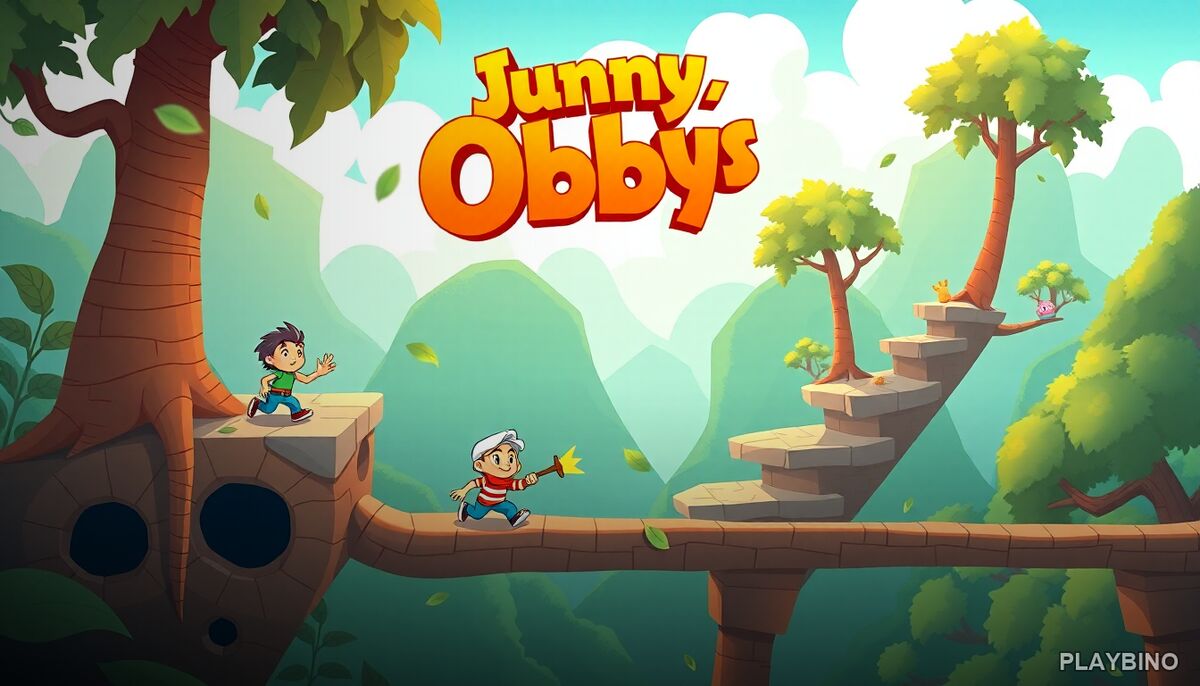
Forest Platforming With a Twist
Most platformers ask you to control one character and reach the end. Funny Obbys flips that setup by putting two brothers on screen at once, each with their own path, their own colored key to find, and their own set of obstacles to clear. Only when both keys are collected does the golden key appear — and only then can the level actually end. Play it directly in your browser and you'll immediately feel how that single rule changes everything about how you approach each stage.
What You're Actually Doing Each Level
The core loop is straightforward: guide both brothers through a forest environment packed with platforms, gaps, and hazards. Each brother follows a distinct route through the level, and the two paths don't always overlap. You're constantly switching focus — jumping one character across a gap, then repositioning the other before a hazard catches them off guard.
The colored key mechanic adds a layer of light puzzle logic on top of the action. You can't just rush forward. Some keys are tucked into corners or placed past tricky platform sequences that require careful timing to reach. The game rewards players who slow down and scan the layout before committing to a jump.
Controls and Timing
Precise jumping is the main skill here. Platforms vary in size and spacing, and the difficulty curve means early levels teach you the rhythm before later stages introduce tighter gaps and faster hazards. Mistimed jumps send a brother back to the start of their route, so patience matters as much as speed.
The Two-Key Unlock System
The golden key only appears once both colored keys are collected. This means you can't finish a level by rushing one brother to the exit while the other lags behind. Both characters have to complete their objectives, which naturally forces you to manage both routes with equal attention. In solo play, that mental juggling act is the real challenge.
Level Design and Escalating Difficulty
Each stage introduces new obstacles and layout ideas rather than just repeating the same patterns at higher speed. Some levels add moving platforms, others place keys in locations that require backtracking or a specific jump angle. The forest setting gives the designers room to create vertical and horizontal challenges within the same level without it feeling cluttered.
The difficulty builds steadily. Early levels are forgiving enough to let you learn the mechanics, but by the mid-game the routes become more complex and the margin for error shrinks. The humor in the game's presentation keeps the tone light even when a particular jump is frustrating you for the third time.
Solo vs. Two-Player Experience
Funny Obbys supports both solo and 2-player modes. Playing solo means you control both brothers yourself, switching between them to navigate each route. It's a genuine cognitive workout — keeping track of two positions, two key locations, and two sets of hazards simultaneously. The 2-player mode changes the dynamic entirely. Each person takes one brother, and suddenly the puzzle becomes about coordination and communication rather than solo multitasking.
Heaven Challenge 2 Player offers a comparable experience for players who enjoy this kind of shared-screen coordination — that game's challenge structure is worth exploring if the two-character format appeals to you.
Who This Game Suits
- Players who enjoy action-puzzle hybrids with platforming mechanics
- Anyone looking for a local 2-player game that requires actual cooperation
- Solo players who want a mental challenge beyond simple reflex-based platforming
- Fans of forest-themed obstacle courses with escalating stage complexity
Funny Obbys sits in a comfortable space between casual and genuinely demanding. The humor keeps it approachable, but the two-key system and dual-route design give it enough depth to stay engaging well past the opening levels. PlayBino hosts the game with no download required, so you can jump into a run whenever you have a few minutes to spare.