Gunshot Odyssey: Fast-Paced Shooting and Platforming Action
What Kind of Game Is This?
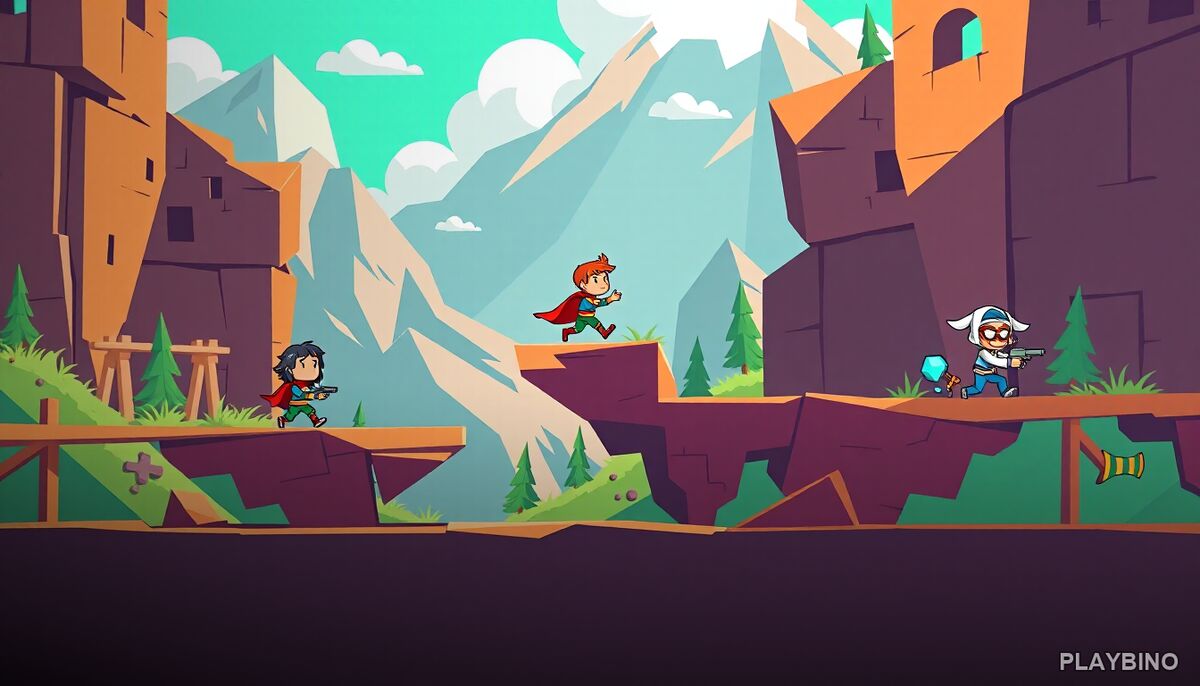
Gunshot Odyssey sits at the crossroads of arcade shooting and platforming, demanding both sharp aim and quick movement decisions at the same time. You are not just blasting through enemies — you are also navigating platforms, dodging environmental hazards, and hunting for power-ups hidden across colorful stages. The combination creates a rhythm that feels different from a pure shooter or a pure platformer. Play it directly in your browser and the pace becomes clear within the first few seconds.
Movement and Combat Working Together
The core mechanic that defines this game is the interplay between jumping and firing. You cannot treat movement and shooting as separate concerns. Enemies emerge from multiple directions, so holding a position rarely works for long. Chaining a jump between two platforms while landing shots mid-air is not just satisfying — it is often the only way to survive a dense wave.
Platforming Feel
The jump physics feel responsive rather than floaty. Platforms are spaced to create decisions: do you push forward aggressively or hold back to clear the current wave first? Timing matters more than raw speed. A well-timed jump that clears a gap while avoiding a projectile feels earned.
Shooting Mechanics
Aim is precise enough that careless shots waste time and leave you exposed. Enemy patterns shift between stages, so reading incoming threats quickly becomes a key skill. Some enemies require more shots, others move unpredictably, and the game does not always telegraph which type is coming next.
Enemy Patterns and Stage Hazards
Each level introduces new enemy configurations alongside environmental obstacles. Early stages give you space to learn the shooting rhythm. Later stages compress that space with hazards that punish mistimed jumps or slow reactions. The hazards are not random — they follow patterns that reward observation. Players who slow down briefly to read a stage layout tend to survive longer than those who rush forward.
- Waves of enemies that increase in density across stages
- Environmental hazards layered on top of combat pressure
- Power-ups scattered through the level that reward exploration
- New obstacle types introduced progressively to prevent repetition
Power-Ups and Progression
Scattered throughout each stage are power-ups that shift the combat balance temporarily. Finding them requires some exploration rather than a straight run through the level. This creates a secondary decision loop: push forward quickly or deviate slightly to grab an upgrade that could make the next wave easier. The power-up placement feels deliberate, often positioned near riskier platform routes to make the trade-off meaningful.
Who Will Enjoy This Game
Gunshot Odyssey suits players who like action games that demand both spatial awareness and shooting accuracy simultaneously. It is not a slow-paced experience. The arcade structure means runs are self-contained and progress builds through skill rather than grinding. If you enjoy movement-heavy games with aerial mechanics, Flying Man 3D takes a different approach to the same energy — that aerial action experience is worth a look alongside this one.
Why the Arcade Format Works Here
The arcade structure keeps the game focused. There are no menus to navigate between every attempt, no lengthy cutscenes, and no padding. Each stage is a contained challenge that tests the specific combination of platforming and shooting the game is built around. PlayBino hosts the game in-browser, so there is no installation required and the controls respond immediately. The escalating difficulty across levels means the game stays challenging without feeling unfair — new mechanics are introduced gradually enough that the learning curve feels natural rather than steep.