Hydro Racing 3D: Speedboats, Split-Screen, and Water Track Strategy
What Kind of Racing Game Is This?
Hydro Racing 3D shifts the racing simulation genre off the asphalt and onto open water. Instead of cars and highways, you're piloting speedboats across wave-cut courses that demand a different kind of spatial awareness. The physics feel distinct from land racing — momentum carries differently, corners require earlier setup, and the water surface adds a layer of unpredictability that keeps each lap interesting. Play it directly in your browser and the difference is immediately noticeable from the first turn.
Career Mode and Progression
The career mode structures the experience into chapters, each introducing new track layouts and progressively tougher AI opponents. Early chapters act as a warm-up, letting you get comfortable with your boat's handling before the difficulty climbs. Later chapters add more technical sections and tighter margins for error.
Nitrous Management
Nitrous boosts are central to competitive racing here. Knowing when to burn your boost — on a long straight versus entering a corner — can be the difference between first and third place. Saving nitrous for the final stretch of a close race is often smarter than spending it early, especially on tracks where the course tightens near the finish.
Boat Handling Differences
Each boat handles differently, and that matters more than it might initially seem. Some boats turn sharply but lose momentum quickly; others carry speed through bends but need wider entry lines. Spending time with a single boat before switching helps you internalize its behavior and race more consistently across a chapter.
Water Parkour Sections
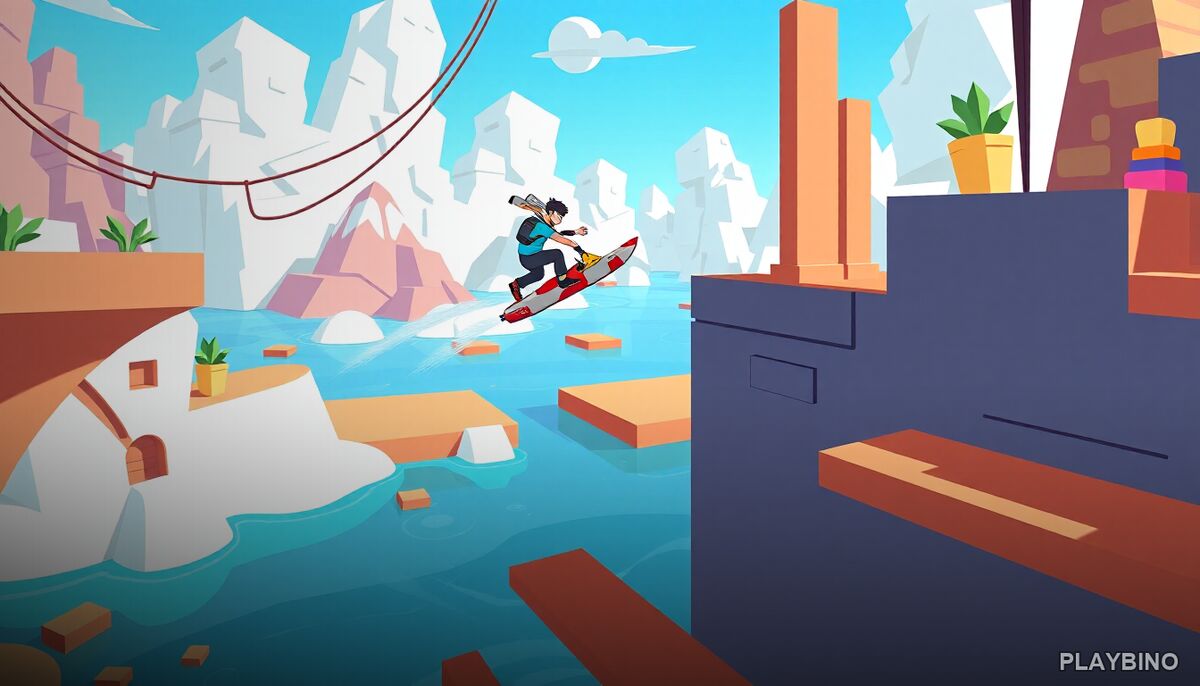
One of the more unusual mechanics in this racing simulation is the water parkour segments embedded within certain tracks. These aren't just decorative — they interrupt the flow of straight-line racing and demand precise maneuvering at speed. Missing a section or clipping an obstacle can cost several seconds, which makes them high-stakes moments in otherwise clean races. They reward players who scout the route mentally before committing to full speed.
Multiplayer and Free Drive
The two-player split-screen mode is one of the strongest reasons to return to the game after clearing career chapters. Local multiplayer racing on the same screen adds a competitive layer that the AI simply can't replicate — reading your opponent's line and cutting them off mid-corner is a different experience entirely. The split-screen performance holds up well enough to keep races readable for both players.
Free drive mode strips away timers and opponents entirely. It's a useful tool for learning track layouts without pressure, and it also works as a low-stakes session when you just want to cruise the water environments without competing. The two modes together — structured career and open free drive — give the game more flexibility than a pure racing title typically offers.
Who This Game Suits
Hydro Racing 3D works well for players who enjoy racing games but want something that feels different from standard road racing. The water physics and boat handling create a simulation feel without being overly complex. The multiplayer component makes it a natural choice for two players sharing a screen, while the career mode gives solo players a clear progression path. Two Punk Racing 2 takes a very different approach to competitive racing — that alternative racing experience is worth a look if you want to compare styles. PlayBino hosts both titles alongside a wide range of browser-based racing and simulation games.
- Career mode with chapter-based difficulty progression
- Nitrous boost system that rewards tactical timing
- Multiple boats with distinct handling characteristics
- Water parkour sections requiring precision maneuvering
- Two-player split-screen local multiplayer
- Free drive mode for relaxed exploration
Track Strategy and Cornering
On tighter tracks, the biggest gains come from cornering technique rather than raw speed. Entering a bend with too much velocity causes the boat to slide wide, losing time and sometimes making contact with course boundaries. Throttle control through the apex — easing off slightly before the turn and accelerating out — keeps the boat on the racing line and sets up a cleaner exit. On water, this is harder to execute consistently than on land, which is part of what makes the racing feel rewarding when it clicks.