Knife Train Test: Precision Throwing on a Moving Train
What You're Actually Doing
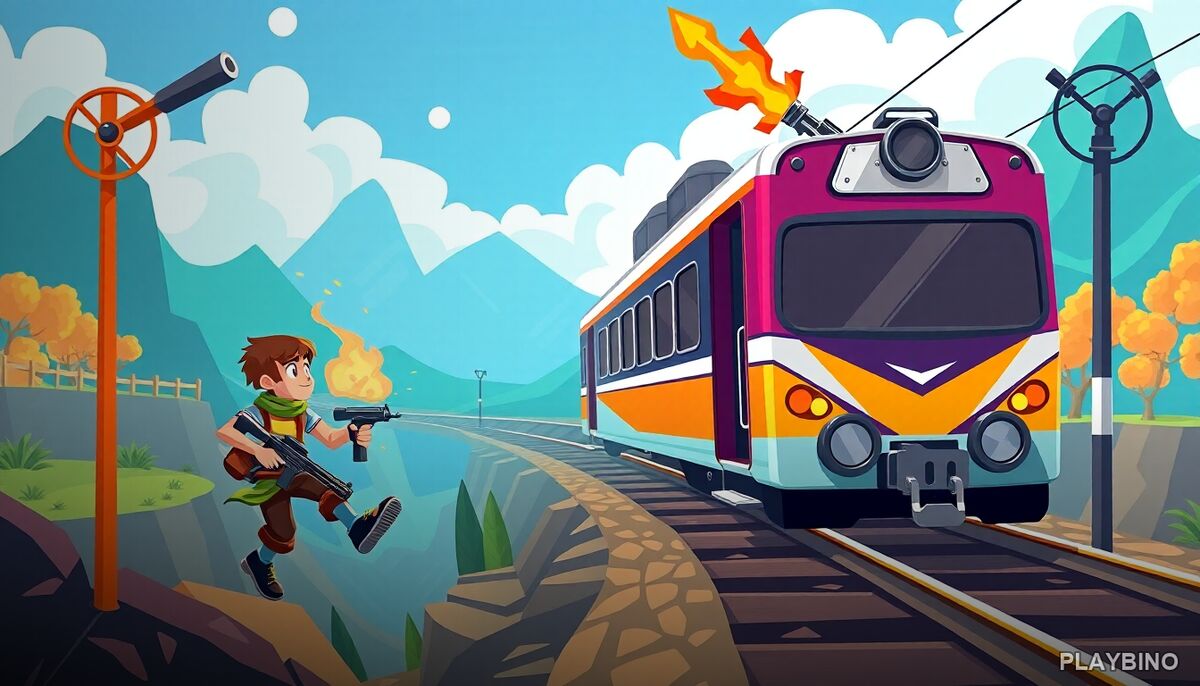
Knife Train Test puts you in a straightforward but demanding situation: a train is moving, targets are appearing and vanishing along the tracks, and you need to land throws with precision timing. Miss too often or hit the wrong moment, and the run ends. The constant motion of the train is not just a visual backdrop — it directly affects when and where you can throw, making every decision feel consequential.
You can play this arcade skill challenge on PlayBino directly in your browser, no download needed. The setup is simple enough to understand in seconds, but the execution takes real practice.
How the Timing Works
The core mechanic is a rhythm built around the train's speed and the appearance windows of each target. Targets don't stay visible for long. Some flash briefly before disappearing behind obstacles, while others require you to anticipate their position before they fully emerge. Throwing too early means the knife hits nothing. Throwing too late means you've already missed the window.
Reading the Pattern
As levels progress, the obstacle arrangements become more complex. You'll start noticing recurring patterns — a gap between two barriers, a target that appears right after a bend, a sequence that repeats every few seconds. Recognizing these patterns is what separates consistent players from those stuck replaying early stages. The game rewards observation as much as reaction speed.
Controlling Your Throws
The controls are minimal, which is intentional. The focus stays entirely on timing rather than complex inputs. Tap or click to throw, and the angle and force are handled by the game's physics. What you control is the moment — and that single variable carries enormous weight when the train is moving fast and targets are stacked close together.
Unlockables and Visual Variety
Knife Train Test includes a selection of unlockable knives and train themes. These don't change the core mechanics, but they do give players something to work toward beyond just a high score. Different knife designs and track environments keep the visual experience fresh without adding unnecessary complexity. It's a clean approach to progression that suits the arcade format well.
What Makes Each Run Harder
The difficulty ramp is gradual but consistent. Early levels give you generous timing windows and straightforward target placements. Later stages introduce tighter gaps, faster train speeds, and obstacle arrangements that force you to plan several throws ahead rather than reacting one at a time. The challenge never feels arbitrary — each increase in difficulty is tied to a specific mechanical change you can identify and adapt to.
- Targets appear and disappear faster at higher levels
- Obstacles begin overlapping, reducing your clear throwing windows
- Train speed increases, compressing reaction time
- Some targets require anticipating position before they're fully visible
Who This Game Suits
If you enjoy action and arcade games that reward focus and repetition rather than luck, this fits well. The scoring system gives you a reason to replay levels even after clearing them, since landing every throw cleanly produces a noticeably better result than scraping through with minimum accuracy. Players who like refining a single skill over multiple attempts will find the loop satisfying.
For something with a different kind of physical challenge — smashing and breaking rather than precise throwing — Box Smasher offers a comparable quick-session arcade experience worth trying between runs.
Scoreboard and Replay Value
Every attempt contributes to your understanding of the level. The scoreboard gives context to your improvement, showing where your accuracy stands relative to previous runs. Because the mechanics are consistent and the patterns are learnable, there's a clear path from struggling on a stage to clearing it cleanly. That sense of measurable progress is one of the stronger aspects of the game's design.
"