Monster Trucks Sky Stunts: Physics, Ramps, and Sky-High Driving
Elevated Tracks and Physics That Punish Mistakes
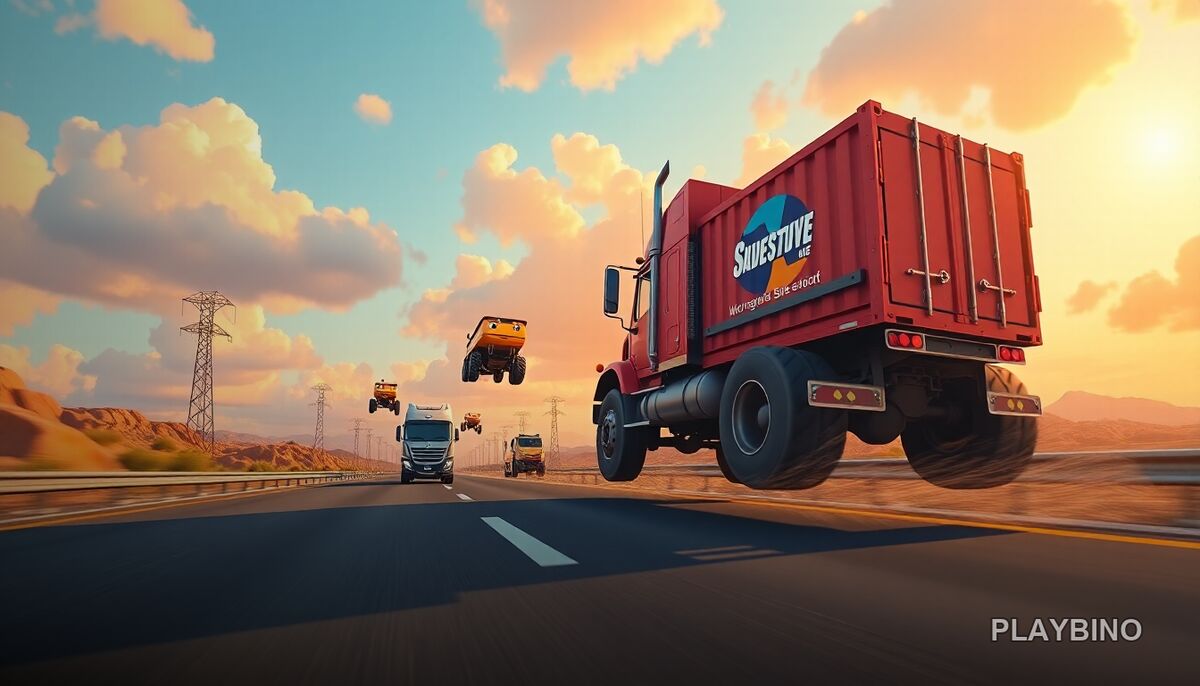
Most monster truck games let you bulldoze through obstacles without much consequence. Monster Trucks Sky Stunts takes a different approach. The tracks are suspended high above the ground, gaps appear between platforms, and the physics engine responds to every input with weight and momentum. One overcorrection at the wrong moment sends your truck off the edge. The game is built around that tension, and it works.
You can play Monster Trucks Sky Stunts directly in your browser without any downloads. The controls are straightforward, but the challenge comes from reading the track ahead and managing how much speed you carry into each section.
How the Driving Actually Feels
The vehicles handle with noticeable weight. Accelerating too hard before a ramp launches your truck at an angle that makes landing cleanly nearly impossible. Holding back too much causes you to stall mid-jump and drop short of the next platform. Finding that middle ground is what the game is really asking you to do on every single jump.
Ramp Timing
Each ramp has an ideal entry speed. Come in fast and you overshoot. Come in slow and you fall short. The game does not tell you what that speed is. You learn it through repetition, which is exactly the kind of skill-based loop that makes arcade racing games satisfying to replay.
Landing and Recovery
Landing nose-down flips the truck. Landing flat keeps momentum. A slightly rear-heavy landing is often the safest approach on narrow platforms because it absorbs the impact and lets you roll forward rather than bounce sideways. Once you understand that, the game opens up considerably.
Coins, Trucks, and Handling Differences
Scattered across the tracks are coins that accumulate between runs. Collecting them unlocks additional trucks, and these are not just cosmetic swaps. Each vehicle has different weight and handling characteristics. A heavier truck holds its line better on flat sections but is harder to correct mid-air. A lighter truck responds faster but is more sensitive to small input errors. Trying different trucks on the same track changes how you approach specific jumps, which adds replay value beyond just improving your time.
Track Variety and What Changes Between Levels
The game includes multiple tracks, and they are not just reskins of the same layout. Some levels are built around chained jumps where momentum from one ramp carries directly into the next. Others break that rhythm with tight corners or narrow platforms that force you to brake mid-sequence. A few tracks introduce loops, which require committing to full speed at the right moment or stalling out at the top.
- Chained jump sequences that reward smooth acceleration
- Narrow platforms that demand precise landing angles
- Loop sections requiring committed speed at entry
- Coin placements that tempt you off the safest line
- Multiple trucks with distinct handling profiles
Strategy for Cleaner Runs
The biggest improvement most players can make is learning to read two or three obstacles ahead instead of reacting to each one individually. If a ramp leads into a tight corner, you need to carry less speed off that ramp than you might instinctively want to. Thinking one step ahead prevents the cascading mistakes that usually end runs.
Coin routes sometimes deviate from the cleanest driving line. Early on, prioritizing coins to unlock trucks faster is worth it. Once you have a vehicle that suits your style, focusing on clean runs without chasing every coin tends to produce better results.
A Similar Challenge Worth Trying
If this style of physics-based monster truck driving appeals to you, another stunt-focused truck challenge covers Monster Truck Stunts Pro, which takes a comparable approach to ramp mechanics and vehicle control. It is worth exploring if you want more of the same feel with a different track structure. Both games are available on PlayBino and share that core loop of managing speed, timing jumps, and recovering from bad landings.