Neon Square Rush: Endless Arcade Precision in a Glowing Corridor
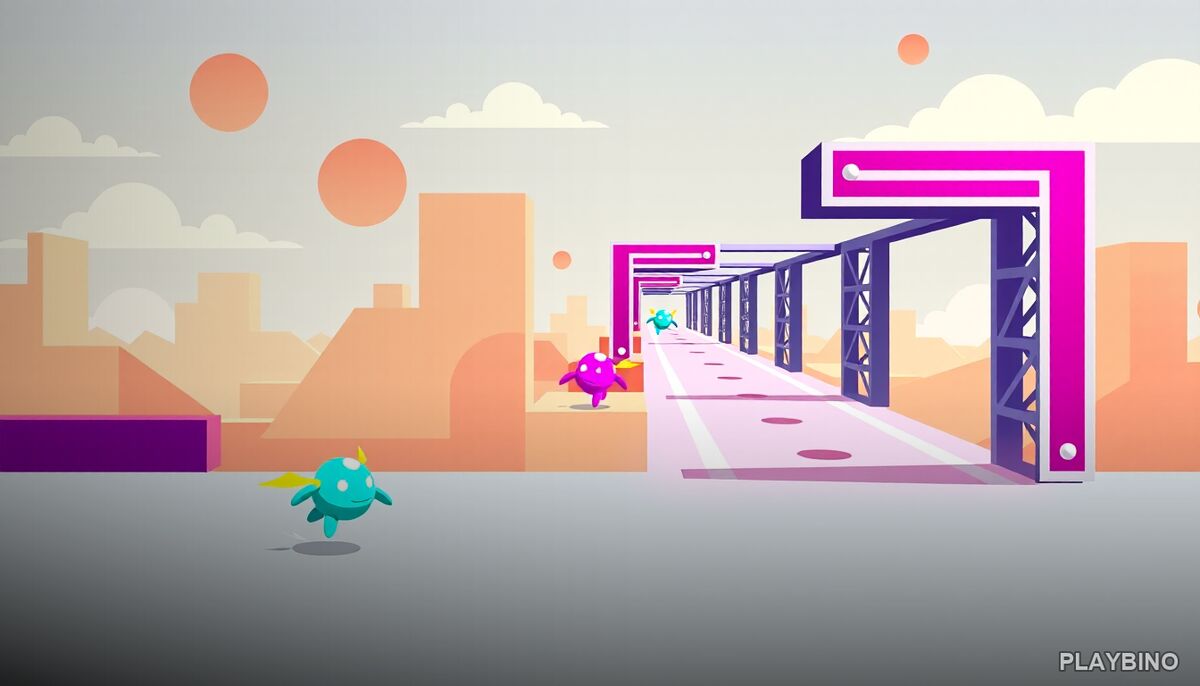
What Kind of Game Is This
Strip away menus, story, and upgrades, and what you get is pure arcade instinct. Neon Square Rush puts a geometric shape in a neon-lit corridor and asks one thing: keep moving. The obstacles ahead never stop coming, and the pace tightens just enough to keep every run feeling urgent. Play the full run in your browser and you'll notice within seconds that this is a game built around focus rather than flash.
How the Movement Works
The controls are deliberately minimal. You steer a square through a corridor of pulsing geometric hazards, reacting to gaps and shifts in obstacle placement. There's no jump curve to master or complex input chain to memorize. The challenge lives entirely in timing and spatial awareness.
Reading the Track Ahead
One of the more interesting design choices here is that the game rewards anticipation as much as reaction. Obstacles don't just appear and demand an immediate dodge — patterns develop over a short distance, and learning to read two or three moves ahead is what separates a short run from a long one. Players who treat it purely as a reflex game will plateau quickly.
Pace Escalation
The speed increase is gradual rather than sudden. This keeps the difficulty curve honest. You won't hit an arbitrary wall; instead, the corridor simply leaves less room for hesitation. Gaps narrow, obstacle clusters grow less predictable, and the margin for error compresses naturally.
Obstacle Design and Difficulty
What makes the obstacle system work is that difficulty comes from placement logic, not from raw speed alone. Early sections teach you the basic hazard types. Later stretches combine them in ways that require you to choose a route rather than just react. Some gaps are traps — the obvious path isn't always the correct one.
- Static barriers that block sections of the corridor
- Moving obstacles that shift timing windows
- Narrowing passages that demand tighter positioning
- Clustered hazard groups that require route decisions
Why Failure Feels Productive
Endless runners live or die by how they handle failure. A run that ends and leaves you annoyed is one you might not repeat. Neon Square Rush handles this well — when you hit something, the moment is clear enough that you immediately understand what went wrong. There's no ambiguity, no lag, no unfair collision. You made a choice, it didn't work, and you can see exactly why. That clarity is what makes the retry loop so immediate.
Extreme Ping Pong Dash Challenge operates on a similar principle of rhythm and reaction — if that kind of fast, skill-driven arcade format appeals to you, that game has its own distinct challenge worth exploring.
Strategy for Longer Runs
Don't Chase the Center
New players tend to default to the middle of the corridor, treating it as the safest position. It isn't. The center is where the densest obstacle clusters tend to form. Learning to commit to one side and shift deliberately is more effective than hovering and reacting.
Rhythm Over Speed
As the pace increases, the instinct is to speed up your decision-making. The more useful adjustment is to settle into a rhythm. The obstacle patterns have internal timing. Fighting that timing by overreacting creates more errors than it prevents. Let the game set the beat and work within it.
Who This Game Suits
If you enjoy arcade games with a clean visual style and no clutter, this one delivers. The neon aesthetic keeps the screen readable even at higher speeds, and the single-player focus means every run is entirely on you. PlayBino hosts a range of browser games in this arcade and endless runner space, and Neon Square Rush fits naturally alongside the faster, skill-focused titles in that catalog. It's a game that rewards patience disguised as a game about speed.