Ninja Evade: Survive the City\'s Mechanical Gauntlet
What Kind of Game Is This?
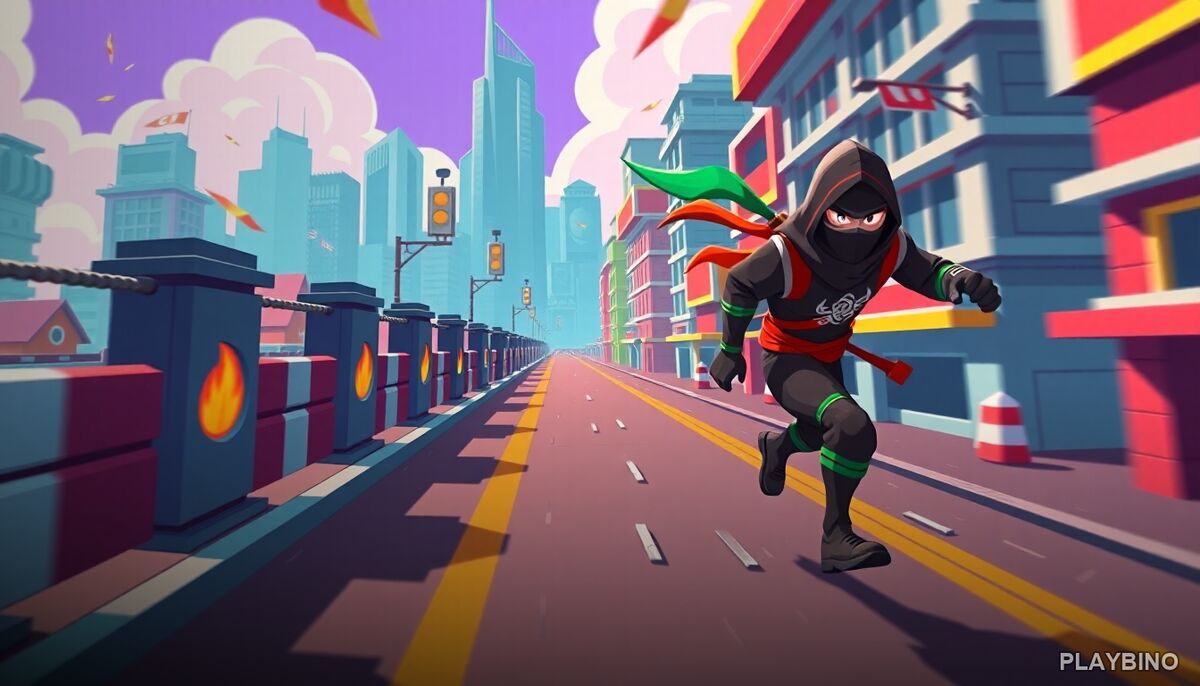
Ninja Evade drops you into a relentless urban environment where a lone warrior is treated as a target by every automated system in the city. It's an endless runner built around action and skill, where momentum is constant and hesitation gets you caught. The city itself becomes the enemy — surveillance drones patrol the air, physical barriers block ground-level movement, and gaps in the terrain punish mistimed jumps. Try the full run and see how far your reflexes carry you.
Movement and Obstacle Flow
The core loop is straightforward: keep moving, read what's ahead, and react fast enough to survive. What makes it demanding is how quickly the environment compounds its threats. A drone hovering at mid-height might force a low dash, only for a barrier to appear immediately after that requires a jump. The game doesn't give you time to breathe between hazards.
Timing Windows
As you push further into a run, the windows for safe passage shrink noticeably. An obstacle that felt avoidable early on becomes a split-second decision later. The game rewards players who develop a rhythm rather than reacting to each threat individually. Anticipating patterns — rather than just responding to them — is what separates short runs from long ones.
Terrain Gaps
Ground-level gaps add a vertical layer to what might otherwise feel like a purely horizontal challenge. Misjudging a jump while a drone is closing in creates pressure that pure speed alone can't resolve. Spatial awareness matters as much as raw reaction time.
Enemy Patterns and Progression
The mechanical sentries in Ninja Evade aren't random. Their patrol behavior follows patterns that become readable with repetition. Early sections introduce drones and barriers at a manageable pace, giving you a chance to internalize the movement options available. Later sections layer these threats together, sometimes placing a drone directly above a terrain gap or positioning barriers in sequences that require chained inputs without pause.
Progression here isn't tied to unlocks or upgrades — it's purely distance-based. The further you survive, the harder the environment pushes back. That simplicity keeps the focus entirely on execution.
Who This Style of Game Suits
Endless runners with a skill-heavy design tend to appeal to players who enjoy short, high-intensity sessions. A run in Ninja Evade can end in seconds or stretch into something genuinely tense depending on how well you're reading the environment. There's no story to follow and no resource management to track — just movement, timing, and pattern recognition.
Players who enjoy action games where personal improvement is the main reward will find the loop satisfying. Each failed run usually has a clear cause, which makes retrying feel purposeful rather than frustrating. Spaceman Escape Adventure follows a similar structure if you're drawn to this kind of escape-and-evade gameplay — another fast-paced browser challenge worth running through.
What the Urban Setting Adds
The metropolis backdrop isn't just visual dressing. Mechanical sentries fit the setting logically — automated defense systems in a hostile city make the ninja's role feel grounded within the game's premise. The environment communicates threat clearly: drones read as aerial hazards, barriers read as ground-level blocks, and gaps in the terrain read as instant failures. The visual language supports quick decision-making, which matters in a game where you rarely have more than a fraction of a second to assess what's coming.
Replay Value and Challenge Curve
The endless format means there's no finish line, which keeps the game open-ended. PlayBino hosts the browser version without requiring downloads or accounts, so starting a run takes seconds. The challenge curve is steep enough to stay engaging past the first few attempts but gradual enough that new players can find their footing before the difficulty spikes hard.
- Obstacle density increases the further you survive
- Drone patrol patterns become more complex in later sections
- Terrain gaps appear more frequently and in tighter sequences
- No checkpoints — each run starts fresh from the beginning
That last point is worth noting. The lack of checkpoints means every run is a complete attempt. It keeps the stakes consistent and prevents the game from becoming something you grind through incrementally. You either clear a section or you start over — which is exactly the kind of pressure an action-skill runner needs to stay sharp.
"