Obby Barry Prison Run: Escape Route, Obstacles, and Strategy
The Setup and Core Goal
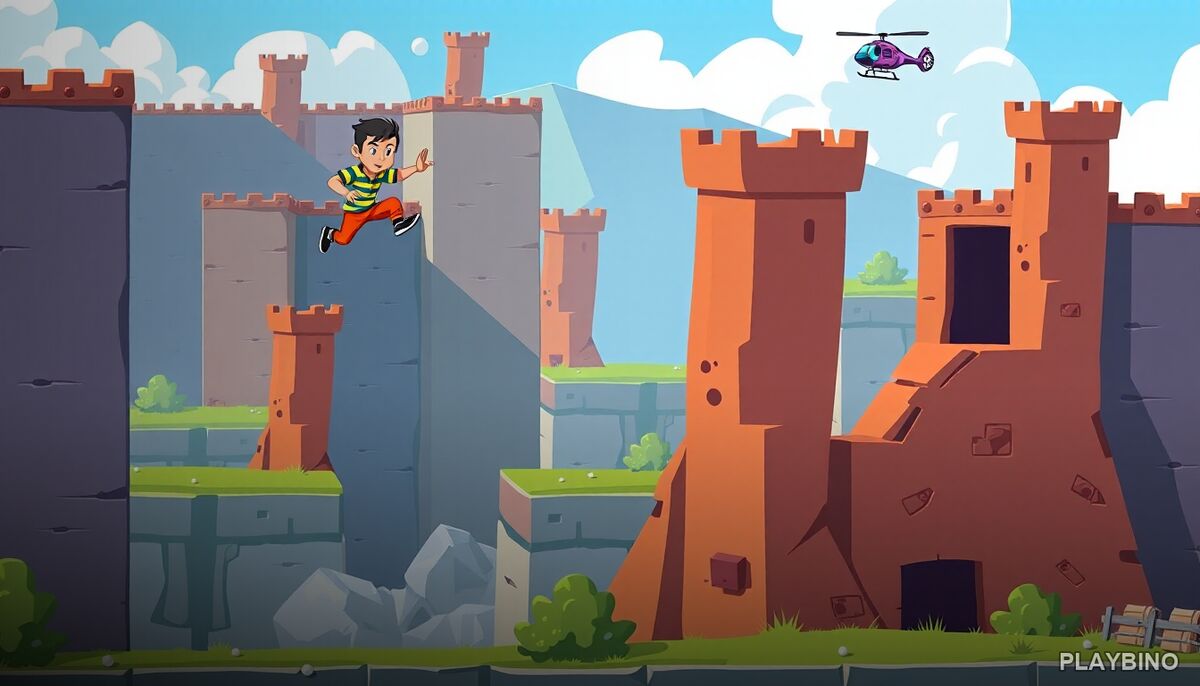
You play as an inmate with one objective: reach the helicopter before getting caught. The course between you and freedom is packed with gaps, elevated platforms, tight corridors, and a patrolling guard who keeps the pressure constant. Every run demands both speed and awareness, since lingering too long in one spot gives the guard time to close in.
The fuel cans scattered across each section add a secondary layer of decision-making. Reaching the helicopter is not enough on its own — you need to collect enough fuel to actually fly out. That mechanic turns what could be a straightforward endless runner into something that requires route planning on top of basic platforming. Try the full escape run to see how quickly the pressure builds from the first section onward.
Movement and Platforming Feel
The controls stay accessible. Jumps are responsive, and the movement system rewards players who stay calm rather than those who rush blindly. Precision matters more than raw speed, especially when navigating narrow platforms over drops or squeezing through tight corridor sections where a mistimed step sends you back.
Timing Your Jumps
Most failed runs come down to jump timing rather than the guard catching up. The gaps between platforms vary in width, and some require a running start while others need a short hop. Reading the layout a half-second ahead of where you are currently standing makes a significant difference in how far each run goes.
Dealing with the Guard
The patrolling guard follows a pattern, but that pattern overlaps with the fuel can locations often enough to force quick decisions. Grabbing a canister while the guard is nearby means committing to a path and moving through it without hesitation. Stopping to recalculate usually ends worse than committing to the initial choice.
Fuel Can Collection Strategy
Not every fuel can sits in an obvious or safe location. Some are placed on elevated side platforms that require a detour, while others sit along the main path but near guard patrol zones. Prioritizing which cans to grab and which to skip based on your current position and the guard's location is the central skill the game builds over repeated runs.
- Cans on the main path are lower risk but may be near guard patrol points
- Elevated platform cans reward detours with higher fuel totals
- Skipping a can is sometimes smarter than risking a capture
- Consistent collection habits build up quickly across longer runs
Obstacle Variety Across Sections
Each section of the prison course introduces a different arrangement of platforms, drops, and corridors. The game does not repeat the same layout endlessly, which keeps the action-skill loop from feeling mechanical. New sections introduce slightly different hazard spacing, which means players cannot rely purely on muscle memory and need to stay visually engaged with what is ahead.
The parkour structure stays grounded rather than abstract. Platforms feel like prison architecture — catwalks, rooftops, maintenance corridors — which gives the obstacle course a sense of place rather than just a series of floating blocks.
Who This Game Suits
If you enjoy action games that reward spatial awareness and steady decision-making over pure reflexes, this one fits well. The skill ceiling is high enough to keep experienced players engaged across multiple attempts, while the accessible controls mean new players can make meaningful progress quickly without a long learning curve.
For a completely different kind of challenge that still rewards control and timing, Big Wheels offers another browser game worth exploring on PlayBino if you want to switch up the genre between runs.
Reaching the Helicopter
The endpoint is always visible as a goal, but getting there cleanly — with enough fuel and without capture — takes several attempts for most players. The final approach often has the densest obstacle arrangement of the run, which means arriving tired or low on fuel creates a tense finish. Managing momentum through the last section rather than sprinting recklessly tends to produce better results.
"