Owl Hunter: Physics Puzzle Strategy in the Dark Forest
Hunting in the Dark
Not every puzzle game announces itself loudly. Owl Hunter sets a quieter, more atmospheric tone — a nighttime forest, a king with a sling, and owls concealed behind stacked barriers. The premise is simple, but the execution demands real strategic thinking. If you want to try it directly, the full browser version is available on PlayBino without any download or setup.
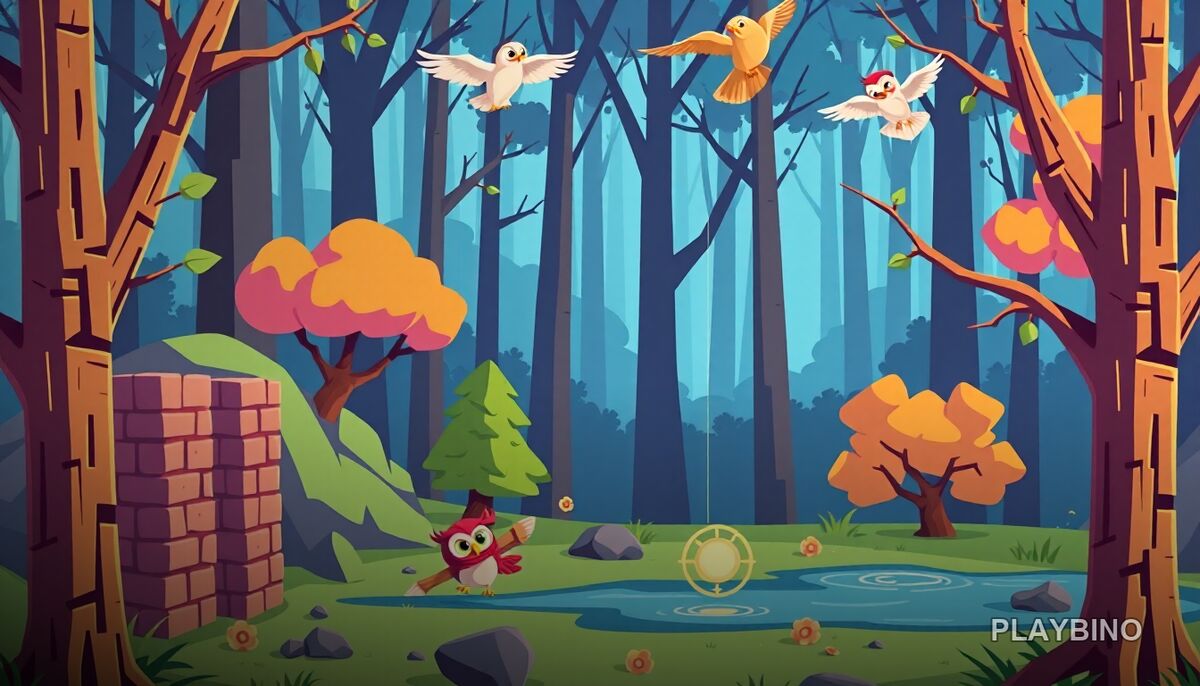
The setting in Willowvale's shadowy woods is more than decoration. Limited visibility and layered obstacle arrangements mean you can't always see exactly what you're shooting at. That uncertainty is part of the puzzle.
How the Sling Mechanic Works
King Alden fires projectiles using a sling, and every shot follows a physics-driven arc. You control the angle and power of each launch, which means trajectory planning is central to every level. Unlike games where you can spam shots and course-correct, Owl Hunter punishes waste. Ammunition is scarce, and running out before revealing all the owls means starting over.
Angles and Trajectory
The game rewards players who think about bounce paths and ricochet potential. Some barriers are positioned so that a direct shot wastes a round, while an angled approach clears multiple obstacles in one go. Learning to read the level geometry before firing is the core skill here.
Obstacle Priority
Not all blocks are equal. Some structures, when broken, cascade and clear nearby barriers automatically. Others are isolated and only worth targeting if they're directly in the way. Identifying which barriers to eliminate first — and which to leave — separates efficient runs from wasted ones.
Level Design and Escalating Complexity
Early levels introduce the basic sling controls and simple barrier arrangements. As you progress, the layouts grow more intricate. Owls get tucked behind multi-layered stacks, and the number of available shots decreases relative to the complexity of the setup. Some levels feel almost like logic puzzles, where the sequence of shots matters as much as the aim itself.
The physics engine adds unpredictability. Blocks don't always fall in the direction you expect, which means rigid planning has limits. Good players adapt mid-level when a shot lands differently than anticipated.
Strategy Tips Worth Knowing
- Survey the full level before firing your first shot. Identify where each owl is hidden and which barriers block the most targets.
- Look for chain reactions. Hitting a structural support block can topple an entire stack and reveal multiple owls at once.
- Conserve shots on early obstacles when possible. The harder reveals usually come later in each level.
- If a level feels stuck, try a completely different entry angle. Sometimes the obvious shot path is the least efficient one.
- Pay attention to block material differences — some break more easily and affect how debris scatters.
Who This Game Suits
Owl Hunter sits at the intersection of puzzle, strategy, and skill. It's not a reflex game — there's no timer pushing you to rush. The satisfaction comes from working out a clean solution with minimal shots, then executing it precisely. Players who enjoy physics-based destruction games will find familiar mechanics here, but the strategic layer around ammunition management gives it a distinct identity.
The nighttime forest atmosphere also makes it feel slightly different from the typical bright, cartoonish puzzle game. It's a small detail, but it adds a sense of focus that suits the methodical pace.
A Different Kind of Browser Puzzle
If the puzzle-strategy combination appeals to you, it's worth exploring what else the genre offers. Tung Tung Sahur takes a different approach to browser-based challenge — you can read more about how it plays in this look at a comparable browser puzzle experience. The two games share a focus on timing and decision-making even if the surface mechanics differ.
Owl Hunter doesn't overstay its welcome in any single level. Each stage is compact, the physics feel responsive, and the challenge scales in a way that keeps the puzzle logic fresh without becoming repetitive too quickly.