Pumpkin Of Goo: Physics Puzzles and Purple Blobs
What You're Actually Doing
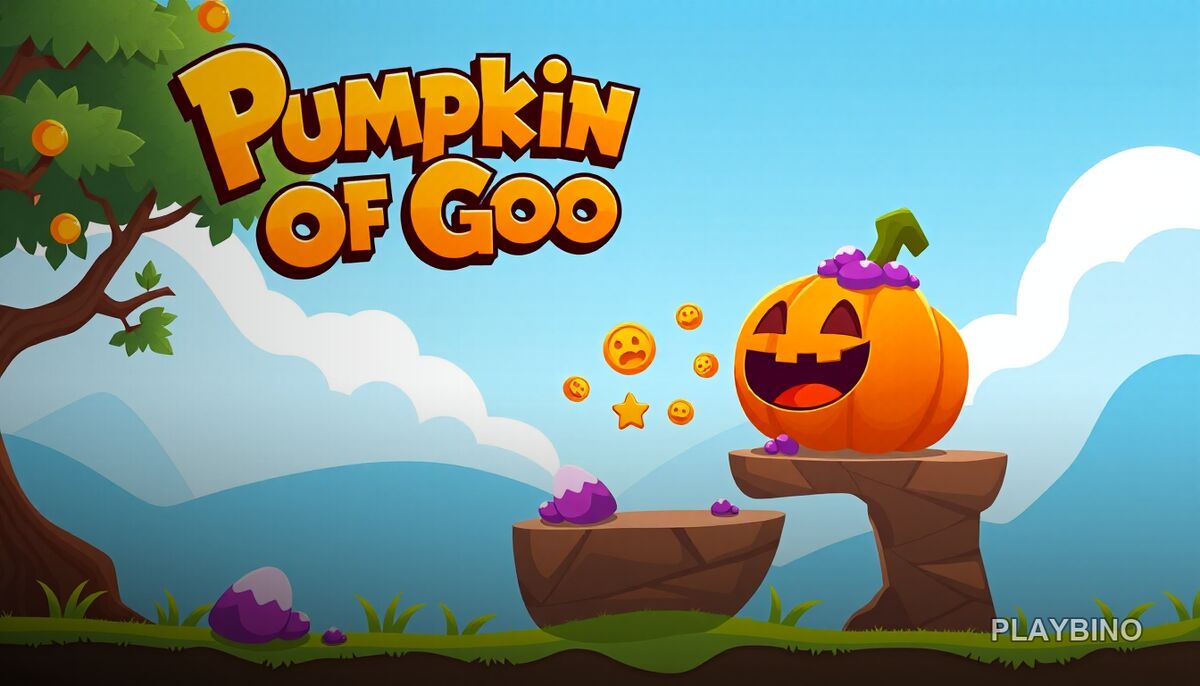
Each level in this single-player puzzle game gives you one job: collect every blob of purple Goo scattered across a physics-driven stage. The catch is that your pumpkin rolls, bounces, and slides according to real momentum logic, so getting from point A to point B rarely means going in a straight line. Try the full run on PlayBino and you'll quickly notice that the first few levels feel approachable, then the terrain starts demanding more deliberate decisions.
The purple Goo blobs are the target, but the path to each one is the actual puzzle. Some sit on elevated platforms that require a well-timed run-up. Others are tucked into corners where too much speed sends you rolling right past them. The satisfaction of squashing a blob is real, but it only lands when you've actually solved the route to reach it.
How the Physics Feel
The movement in Pumpkin Of Goo is momentum-based, which means the pumpkin doesn't stop the moment you release a key. Slopes accelerate it. Barriers redirect it. Tight corridors slow it down and demand precision. This creates a gameplay feel closer to a physics sandbox than a traditional tile-based puzzle, and that distinction matters for how you approach each stage.
Using Slopes and Speed
Building speed on a downward slope to clear a gap is one of the core mechanics. The angle of the terrain determines how fast you'll be moving at the bottom, and misjudging that speed is one of the most common ways to overshoot a Goo blob or miss a landing entirely. Learning to read slopes before committing to them is a skill that develops naturally over the first several levels.
Navigating Tight Spaces
Some stages deliberately funnel the pumpkin into narrow sections where momentum becomes a liability. Here the puzzle shifts from speed management to patience. Letting the pumpkin slow naturally, or using a wall to bleed off speed, often works better than trying to force a precise stop. These sections reward players who've internalized how the physics behave rather than those who react on instinct.
Level Design and Progression
The stage layouts introduce new terrain types and obstacle configurations at a steady pace. Early levels establish the basics: flat platforms, simple gaps, a handful of Goo blobs in obvious positions. Mid-game stages start layering in barriers that redirect your path, elevated terrain that requires specific approach angles, and Goo placements that force you to plan a route rather than improvise one.
The difficulty curve feels earned rather than arbitrary. Each new challenge builds on something the previous level taught, which keeps the learning process from feeling punishing. Completing a stage where you've clearly solved a spatial problem produces a different kind of satisfaction than just clearing an obstacle by luck.
What Kind of Player This Suits
- Players who enjoy physics-based movement and momentum puzzles
- Anyone who likes single-player skill challenges with clear objectives
- Puzzle fans who prefer spatial reasoning over abstract logic
- Casual players looking for short sessions with meaningful progression
The colorful presentation keeps the tone light, but the underlying puzzle design has real depth. It's not a game that demands long sessions, but it rewards returning to a stuck level with fresh eyes.
Strategy That Actually Helps
Before rolling, scan the full stage layout. Identify where each Goo blob sits relative to the terrain, and mentally map a route that accounts for how momentum will carry the pumpkin between collection points. Committing to a path without that mental model leads to a lot of restarts.
When a stage keeps failing at the same point, the issue is usually approach speed. Either slow down earlier or take a different line into the problem area. The physics are consistent, so a repeated failure almost always means the same input is producing the same result. Changing the angle or timing of an approach is usually more effective than trying to execute the same move more precisely.
A Similar Puzzle Experience
If the spatial reasoning and physics logic here appeal to you, another puzzle-based challenge worth trying is Rotating Boxes, which takes a different mechanical approach but shares that same focus on thinking through a problem before acting. Both games reward observation over reflexes.