Real Bus Parking Pick and Drop: City Bus Driving Simulation Guide
What This Game Asks of You
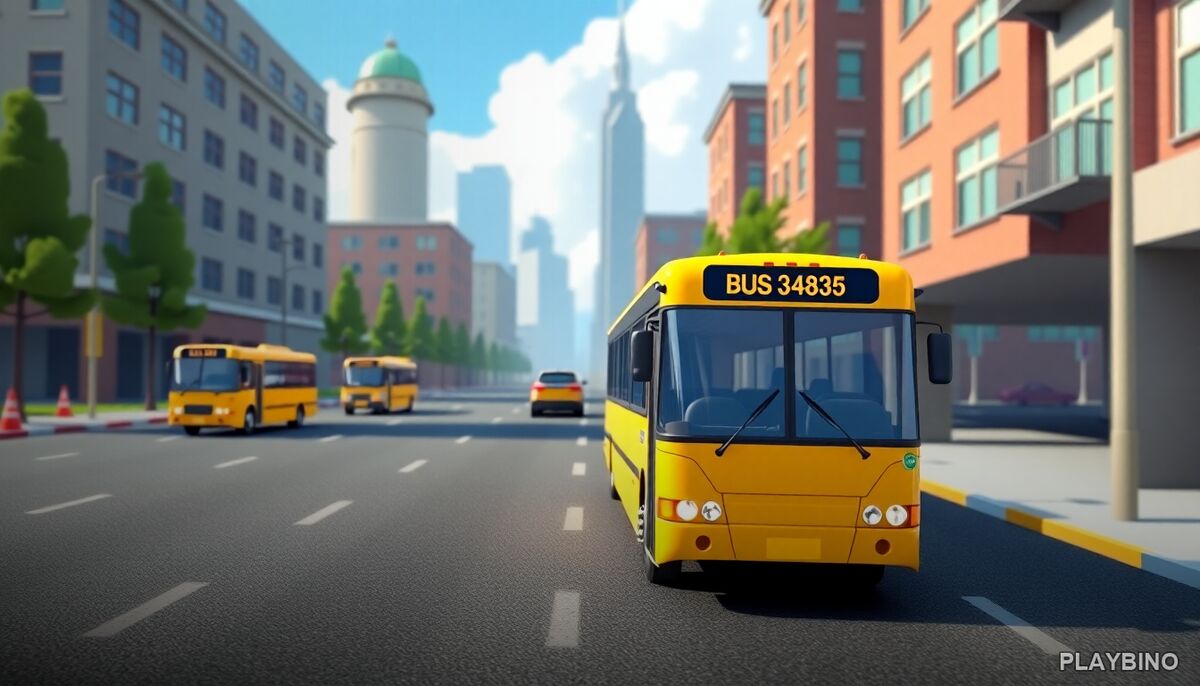
Driving a city bus through packed urban streets sounds straightforward until you have to squeeze it into a marked bay without clipping the curb. Real Bus Parking Pick and Drop puts you behind the wheel of a full-sized bus and immediately makes you feel the weight of that responsibility. Every route has passengers waiting, time ticking, and narrow gaps that demand real spatial awareness. If you enjoy vehicle simulation with a skill-based edge, this browser driving challenge on PlayBino is worth your attention.
Route Structure and Progression
The game is built around a series of routes that grow more demanding as you advance. Early levels introduce basic pickup and drop-off mechanics with relatively open roads. Later stages tighten the margins considerably, placing bus stops in awkward positions, adding pedestrian traffic, and reducing the time available to complete each run.
Each route has a clear loop: navigate to the marked stop, park accurately within the designated zone, load passengers, then move on to the next location. The loop sounds repetitive, but the challenge shifts constantly as the environments change and the obstacles stack up.
Time Pressure
A countdown runs throughout each route. You cannot afford to take wide, cautious turns on every corner. The simulation pushes you to find a balance between speed and control, which is where the skill component becomes most visible. Rushing causes positioning errors; being too cautious burns the clock.
Parking Zones
Stopping accurately inside the marked zone is not optional. Partial stops or misaligned parking affect your score and can fail the objective entirely. The game rewards clean, deliberate entries into each bay rather than last-second corrections.
How the Physics Shape the Experience
The realistic physics are the core of what makes this simulation feel different from simpler arcade racers. The bus does not snap into position or forgive sharp inputs. Braking takes distance. Turns require anticipation. If you swing the wheel too late on a corner, the rear of the bus drifts wide and clips whatever is beside it.
This physicality makes every successful parking maneuver feel earned. Players who approach it like a racing game will struggle early. Those who treat it like a precision driving exercise will adapt faster and find the rhythm of each route.
Controls and Spatial Awareness
Getting comfortable with the controls is the first real hurdle. The bus responds to input with a slight delay that reflects its size and momentum. Learning to steer slightly ahead of where you want to go, rather than reacting to where you already are, is the adjustment most players need to make.
- Brake early before tight turns to maintain control through the corner.
- Use small steering corrections rather than large swings to avoid overcorrection.
- Watch the rear of the bus in narrow spaces, not just the front.
- Approach parking zones at low speed to give yourself time to align.
- Scan ahead for pedestrians and traffic before committing to a lane.
Who This Game Suits
Players drawn to simulation and skill-based driving games will find the most satisfaction here. The game does not rely on combat, power-ups, or random events. Success comes entirely from reading the road, managing the vehicle's momentum, and executing clean stops under time pressure. It rewards patience and spatial thinking over reflexes alone.
If you enjoy this kind of vehicle control challenge, a comparable simulation worth exploring is the Wheel Chair Driving Simulator, which takes a different approach to navigation and precision movement in a browser setting.
Scoring and Replay Value
Performance is measured by parking accuracy, time remaining, and passenger delivery success. Each route can be replayed to improve your score, and the progressively tighter layouts give experienced players something to work toward. The simulation loop stays engaging because the physical challenge of maneuvering a large vehicle never fully disappears, even on familiar routes.