Rescue Kitty Puzzle: Physics Bouncing and Spatial Logic in Your Browser
What Kind of Game Is This?
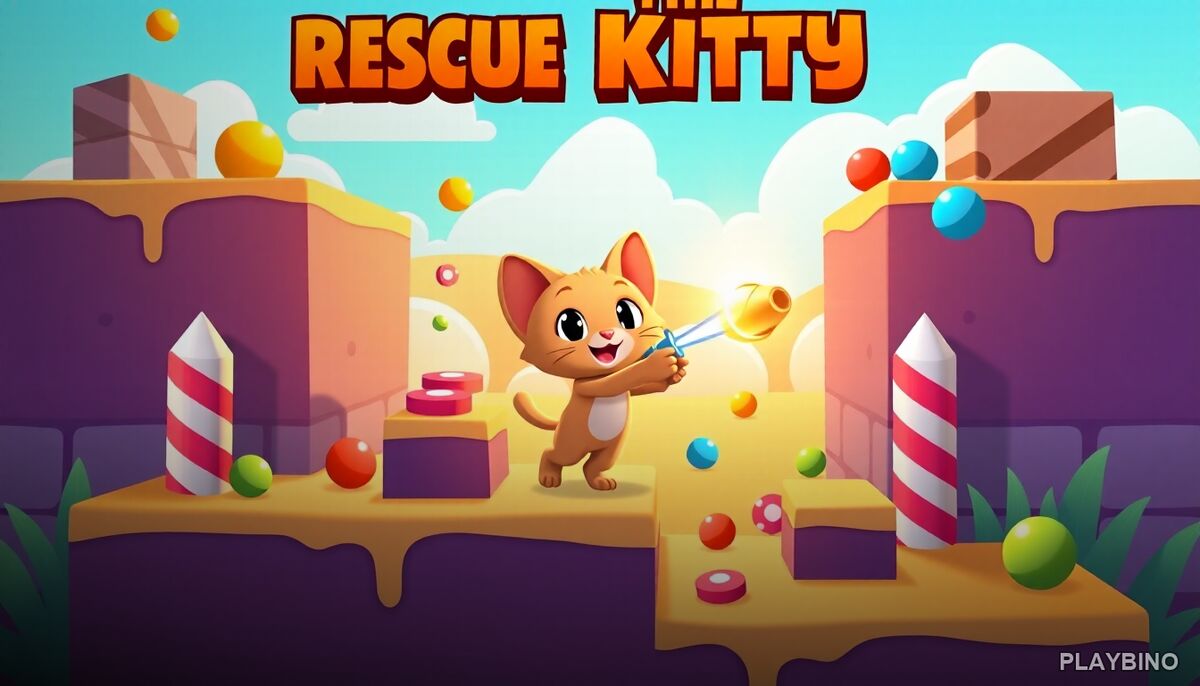
Rescue Kitty Puzzle sits firmly in the logic and spatial reasoning category. It is a single-player puzzle game built around momentum, wall bounces, and trajectory planning. The premise is simple: a kitten is trapped, and you need to guide it to the exit. The execution, however, demands real thinking. Each level is a contained maze where the physics engine does the heavy lifting once you release the cat in the right direction.
The drag-and-release mechanic is the core of everything. You pull the kitty in one direction and let go, sending it flying the opposite way. From there, it ricochets off walls until it either reaches the goal or comes to a stop somewhere unhelpful. The online version runs entirely in your browser with no downloads required, making it easy to pick up between other tasks.
The Bounce Mechanic and Why It Matters
Most puzzle games rely on logic grids or pattern matching. Rescue Kitty Puzzle uses physics instead. The angle you choose when dragging determines the entire trajectory, and predicting where the cat will land after two or three bounces requires spatial awareness that builds over time.
Laser Doors
The laser door mechanic adds a layer of planning on top of the basic bounce system. These barriers block the exit and only open after the cat has struck a specific number of walls. That means you cannot simply aim for the shortest path. You need a route that hits enough surfaces to satisfy the door condition while still ending at the exit. Some stages require deliberate detours through tight corridors just to accumulate the right bounce count.
Chain Reactions
When the angles line up correctly, the cat bounces through a sequence of walls in rapid succession, triggering a satisfying chain that feels almost automatic. Getting to that point takes trial and error, but the payoff is noticeable. The game rewards players who take a moment to visualize the full path before committing to a launch direction.
Level Progression and Difficulty Curve
Early stages introduce the drag-and-release system with open layouts and forgiving wall placements. As the levels advance, the mazes tighten, laser doors multiply, and the margin for error shrinks. The complexity ramps gradually rather than spiking suddenly, which gives players time to internalize the bounce logic before the harder configurations appear.
Later levels introduce layouts where a single degree of difference in your launch angle sends the cat into a dead end instead of the exit. At that point, the game shifts from casual puzzle-solving into something closer to a precision spatial challenge. The adorable cat character keeps the tone light even when the geometry gets demanding.
Strategy and Approach
- Count the walls in the stage before launching. Know how many bounces the laser door requires and identify surfaces that fit your route.
- Work backwards from the exit. Identify which wall must be the final bounce, then trace a path that leads there.
- Use corners deliberately. Angled corners redirect the cat in predictable ways once you understand how the physics behave.
- Accept that the first attempt on a new stage is often exploratory. Watching where the cat ends up teaches you more than guessing repeatedly from the same angle.
- Short, controlled launches are sometimes more effective than long diagonal shots across the full stage.
Who This Game Suits
Players who enjoy logic puzzles with a physical component will find the most satisfaction here. The game does not require fast reflexes or precise timing in the traditional sense. The challenge is entirely about reading space, predicting angles, and adjusting your approach after each failed attempt. It works well in short sessions because each stage is self-contained and quick to replay.
Buddy Quest offers a different take on single-player puzzle progression if you want to compare how another browser game handles level-based logic challenges. The two games share a casual tone but approach their mechanics differently.
Spatial Reasoning as the Real Skill
What makes Rescue Kitty Puzzle hold up across its level set is that the core skill being tested is genuine. Understanding how angles translate into bounce paths, mentally simulating a multi-wall trajectory, and adjusting based on partial information are all real spatial reasoning tasks. The cat theme and clean visuals make the game approachable, but the puzzle design underneath is more thoughtful than it first appears. PlayBino hosts the game alongside a range of other logic and arcade titles, making it easy to continue into something similar once you have cleared the available stages.