Slide and Fall: Descending Through Spinning Platforms and Roaming Enemies
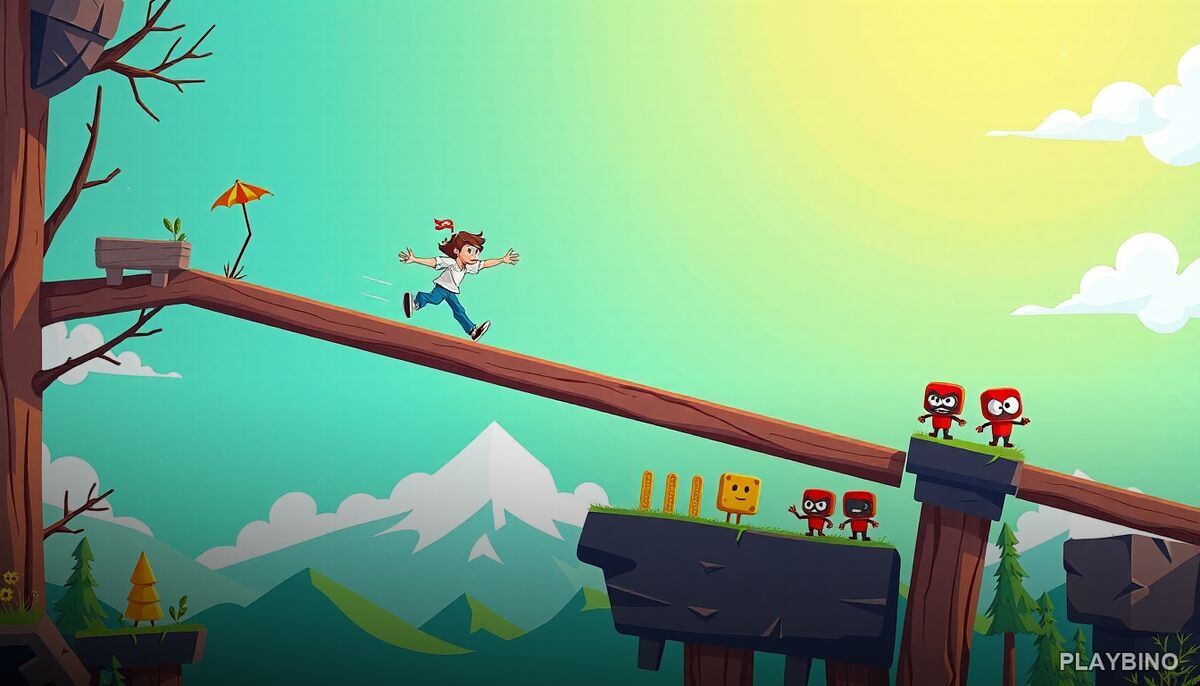
What Slide and Fall Is About
The concept is straightforward: you fall through an endless tower, and every platform between you and the bottom is spinning. Gaps open and close as each platform rotates, and hostile shapes patrol the spaces you need to pass through. The deeper you go, the harder it becomes to predict what comes next. Play the full descent and you quickly realize that reading the environment matters far more than reacting fast.
The minimalist visual style strips away everything that isn't essential. There are no backgrounds competing for attention, no flashy effects obscuring the gaps. Just you, the rotating platforms, and the enemies moving across them. That clarity is part of what makes the game work as an arcade challenge.
How the Descent Works
Each floor of the tower is a platform that spins at its own speed and direction. Your character needs to slip through a gap when one lines up beneath you. Timing that drop is the core action. Hold too long and the gap closes. Move too early and you clip the edge.
Platform Rotation
Platforms don't all spin at the same rate. Some rotate slowly and give you a wider window. Others spin fast enough that the gap appears and disappears in under a second. As you descend deeper, the mix shifts toward faster rotations and tighter gaps, demanding sharper timing on every floor.
Enemy Patterns
Hostile shapes patrol platforms in looping paths. Early on, their routes are simple and easy to anticipate. Further down, multiple enemies share a single platform, their paths overlapping in ways that leave fewer safe windows. The game never announces new enemy behavior — you encounter it mid-run and adapt or fail.
What the Difficulty Curve Feels Like
Slide and Fall scales difficulty without ever showing a level number or a progress bar. The change is felt, not announced. A run that starts feeling manageable will shift into something genuinely tense around the point where fast platforms and multiple enemies start appearing together. That gradual escalation is one of the stronger aspects of this endless runner format — you're always one bad read away from ending a run, but the early floors give you enough time to settle into the rhythm.
Strategy That Actually Helps
- Watch the enemy first, then the gap. Enemies move on a loop. Identify the pattern before committing to a drop.
- Don't rush the gap. Waiting for the right moment beats forcing a drop through a partially open gap.
- Track rotation direction. A platform rotating toward the gap will close it faster than one rotating away. Factor that into your timing.
- Accept short pauses. Hovering above a platform for an extra rotation cycle is safer than guessing on a bad window.
The game rewards patience more than speed. Players who treat each floor as a small puzzle rather than an obstacle to sprint past tend to survive significantly longer.
Who This Game Suits
Slide and Fall fits the single-player arcade space well. It doesn't require fast reflexes so much as calm observation. If you enjoy games where the challenge comes from reading patterns and committing at the right moment, this delivers that consistently. The run length varies entirely based on your decisions, which gives it genuine replay value without adding complexity.
Bunny Funny on PlayBino offers another arcade experience built around timing and quick decisions if you want something in the same space but with a different feel. Both games share that quality of being easy to start but difficult to master over many runs.
The Arcade Loop
Every failed run in Slide and Fall ends quickly, and starting a new one takes no setup. That tight loop — attempt, fail, retry — is what keeps the game engaging over multiple sessions. You don't lose progress in a meaningful way, but you do accumulate a better understanding of how the platforms and enemies behave. That knowledge is what makes later runs feel earned rather than lucky.