Snow Panda: Physics Puzzle Guide – Build Your Tower to the Top
What Snow Panda Actually Is
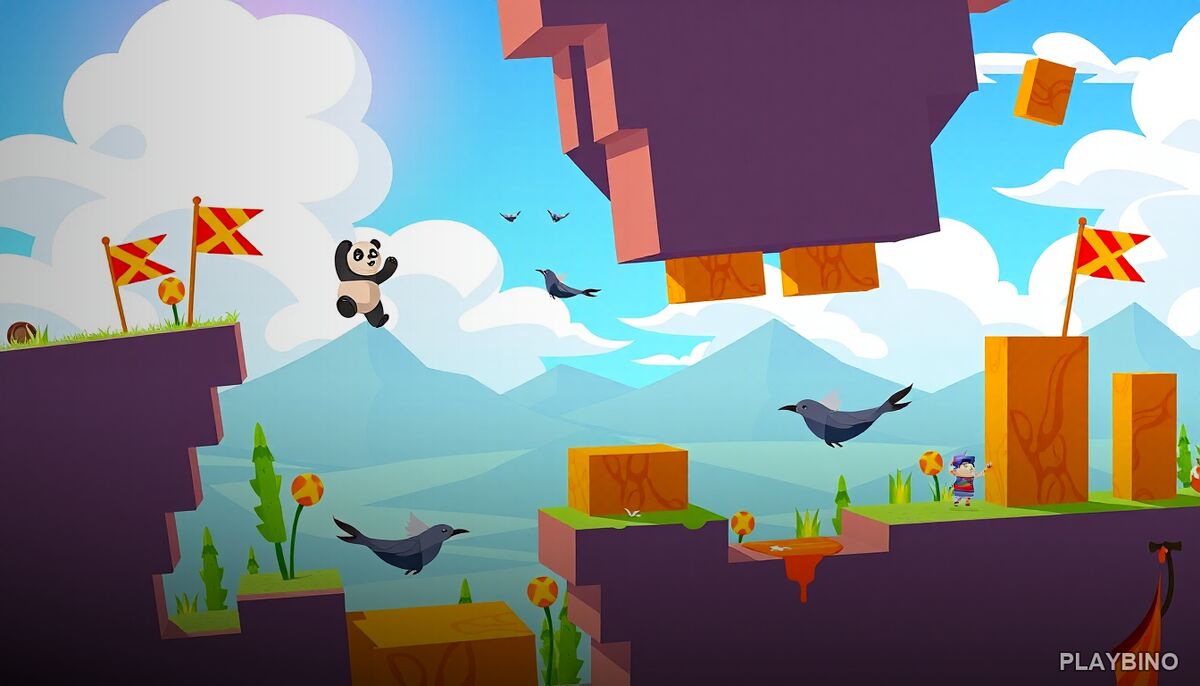
At first glance, Snow Panda looks simple: a bear needs to climb, and you tap to help it get there. But within a few attempts, the real puzzle reveals itself. Each tap generates a block beneath the bear's feet, and those blocks stack into a tower. The catch is that every placement has to fit within narrow vertical passages without touching the walls. One sloppy tap and the whole structure tilts, ending the run immediately.
The game sits firmly in the physics puzzle and skill categories, where spatial awareness matters more than speed. You can play Snow Panda on PlayBino directly in your browser with no downloads required.
The Core Mechanic and Why It Feels Different
Most climbing games move the character automatically or use swipe controls. Snow Panda flips that expectation. You are not steering the bear — you are building the path it walks on. The bear moves upward only when there is a solid block beneath it, so the act of tapping is both construction and navigation at the same time.
This creates a feedback loop that feels surprisingly physical. Blocks have weight and momentum. A block placed slightly off-center will cause the tower to lean, and if that lean pushes against a wall barrier, the run ends. The physics are not punishing for the sake of difficulty — they reward players who learn to read the available space before committing to a tap.
Timing Over Tapping Speed
The instinct is to tap quickly, especially as the passages narrow higher up. But rushing leads to crooked stacks. The better approach is to pause briefly, identify the center of the gap, then tap with intention. A slightly slower rhythm with accurate placement consistently outperforms frantic tapping.
Reading the Space Ahead
Each vertical section has its own width and angle. Before placing the next block, glance at what is coming two or three gaps above. If the passage narrows sharply, a block placed near the edge now will make the next placement nearly impossible. Planning a couple of moves ahead is what separates short runs from successful climbs.
What Makes the Difficulty Escalate
Snow Panda does not simply speed things up to increase challenge. Instead, the passages become more irregular. Some gaps are angled, some are very tight, and some require the tower to be perfectly centered before the bear can continue moving. The escalation feels earned rather than arbitrary, because the same core skill — precise block placement — is what the game tests throughout.
- Early sections: wide passages, forgiving placement windows
- Mid sections: narrower gaps, slight angles that affect tower balance
- Upper sections: tight corridors where even a small lean causes failure
- Final approach: requires near-perfect centering across several consecutive placements
Strategy for Longer Runs
The most consistent strategy is to treat each tap as a deliberate decision rather than a reaction. Here is what tends to work across multiple attempts:
Stay centered by default. When in doubt, aim for the middle of the available space. A centered tower is easier to correct than one that is already leaning.
Accept small corrections early. If the tower starts to tilt slightly, the next block can compensate by being placed on the opposite side. Catching a lean early is far easier than trying to recover from a severe tilt three blocks later.
Slow down at transitions. The moments where passage width changes are the most dangerous. A brief pause before placing a block in a new section prevents the common mistake of carrying momentum from a wider gap into a narrower one.
Who This Game Suits
Snow Panda works well for players who enjoy single-player puzzle challenges that reward patience and observation. It is not a reflex game in the traditional sense — the challenge is spatial and logical rather than purely reactive. If you have enjoyed block-stacking or physics-based puzzles before, the mechanics here will feel familiar but distinct.
Players who prefer a comparable block-based challenge might find another puzzle built around blocks worth exploring alongside this one.
Minimalism as a Design Choice
The clean visuals are not just aesthetic — they serve the gameplay. With no background clutter or distracting animations, your full attention stays on the tower and the passage ahead. The minimalist approach means the game communicates everything it needs to through the physics alone. When the tower starts to lean, you see it immediately. When a passage narrows, the walls make it obvious. Nothing is hidden, which keeps the puzzle fair even when it is difficult.