Space Driving: Survive the Celestial Maze
What You're Actually Doing
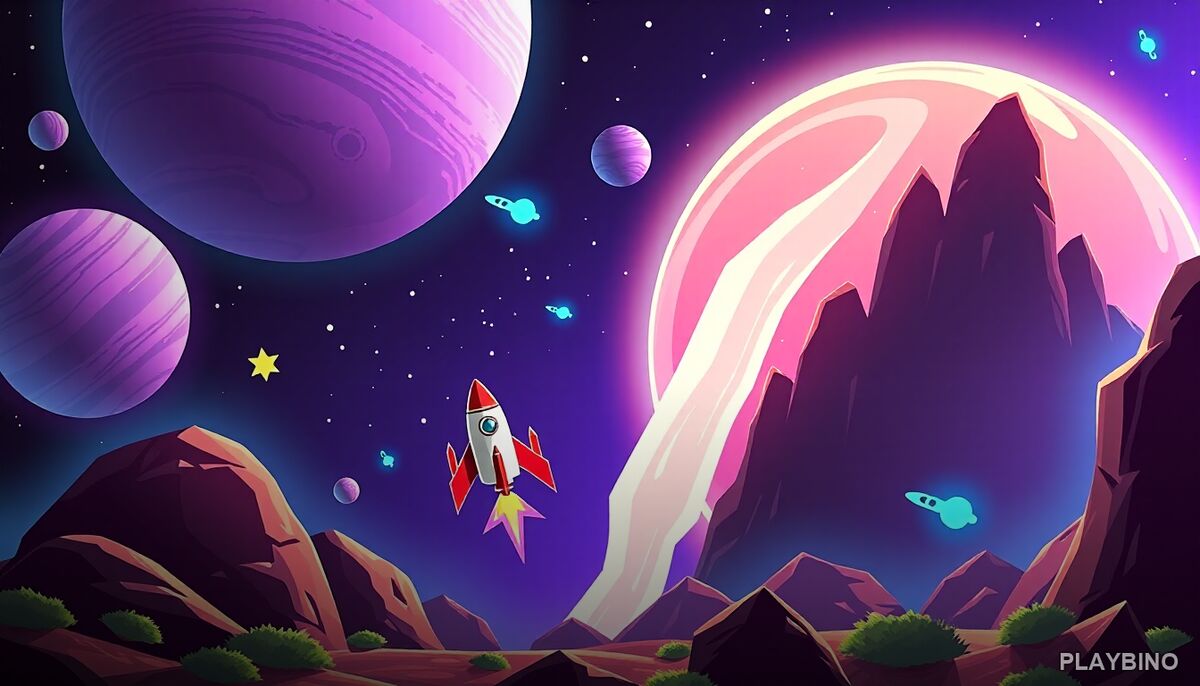
Space Driving drops you into a dark, minimalist cosmos where massive planets drift across your path and scattered stars beg to be collected. Your rocket moves forward automatically, and your job is to steer through the gaps before celestial bodies close them off. The premise is simple, but the execution demands sharp reflexes and calm decision-making under mounting pressure. Play it directly in your browser and the difficulty escalates faster than most endless runners of this type.
How the Controls Shape the Challenge
The control scheme is deliberately stripped back. You guide the rocket left or right, adjusting your trajectory as planets approach from unpredictable angles. There are no power-ups to lean on, no shields to absorb a bad move. Every decision is yours alone.
Timing Over Speed
Rushing through gaps rarely works. The planets move at their own rhythm, and matching that rhythm — rather than fighting it — is what separates a short run from a long one. Patience creates openings; impatience creates collisions.
Reading Approach Angles
Planets don't always come straight at you. Some drift in from the sides, others close in diagonally. Learning to read the angle of approach a second or two ahead is the core skill the game builds over repeated runs. Each collision teaches you something about spatial awareness.
The Star Collection Loop
Stars are scattered across the darkness, and collecting them drives your score upward. The catch is that each star you grab accelerates the overall pace of the game. This creates a genuine tension: chasing stars is how you score, but it also shortens your survival window. Deciding when to push for a star and when to prioritize safe positioning becomes a real strategic layer as runs progress.
Why the Minimal Design Works
There are no distracting backgrounds, no flashy UI elements competing for attention. The visual language is clean — dark space, large planets, small stars. This restraint is intentional. When the screen starts filling with overlapping planetary bodies, you need every bit of visual clarity available. The arcade aesthetic keeps the focus entirely on movement, spacing, and timing rather than spectacle.
- Endless runner structure with no fixed level limit
- Score tied directly to star collection
- Pace increases organically as you collect more stars
- Single-player format built around personal best improvement
- Minimalist visuals that support spatial awareness
Survival Strategy for Longer Runs
The players who last longest in Space Driving tend to share a few habits. They stay near the center of the screen when possible, preserving escape routes in both directions. They resist the urge to collect every star and instead prioritize positioning when the screen gets crowded. And they treat each run as a data point — noting which planet configurations caused the previous crash and adjusting their default path accordingly.
ZigZag Glide offers a similar arcade experience built around momentum and narrow paths, and comparing the two shows how differently games in this space can approach the same core tension of movement versus obstacle density.
Who This Game Suits
If you enjoy arcade games that reward repetition and incremental improvement, Space Driving fits naturally into that category. It's the kind of game where a run lasts anywhere from fifteen seconds to several minutes depending on your focus level. There's no story, no unlockables — just the score, the rocket, and the planets. PlayBino hosts the game with no download required, making it easy to jump in for a quick session whenever the mood strikes.