Swipe To Park The Cars: Puzzle Logic and Parking Strategy
What Kind of Puzzle Is This?
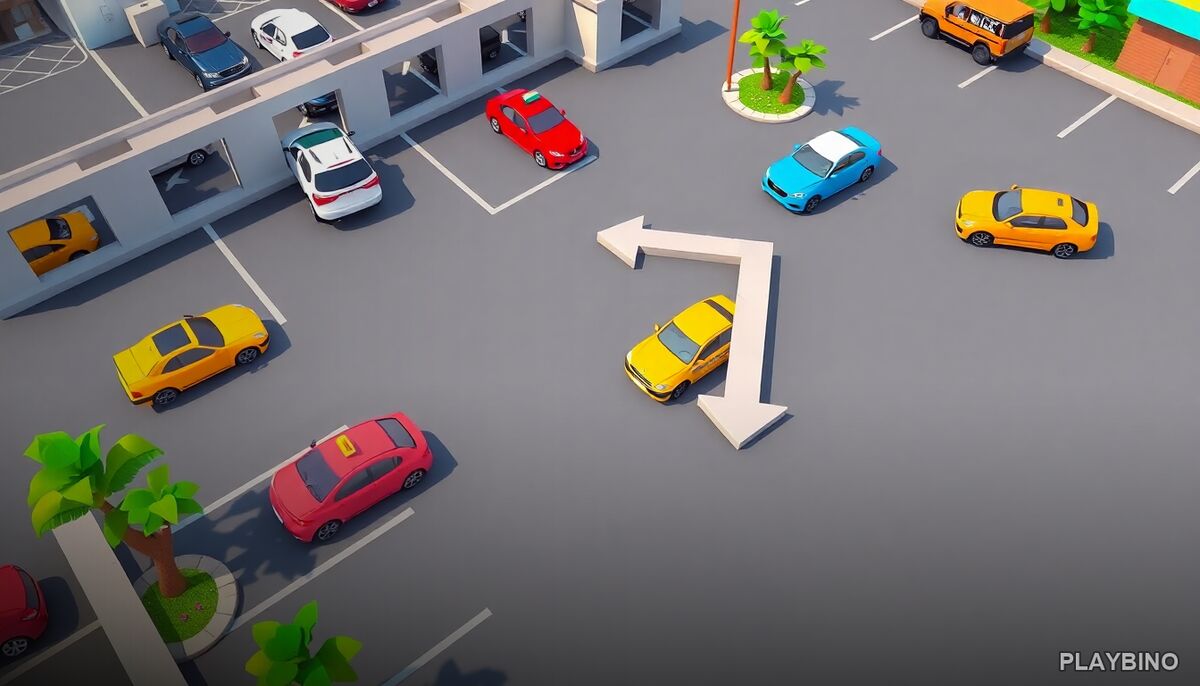
Parking puzzles occupy a satisfying niche in browser gaming — they look simple at first glance but quickly reveal layers of spatial logic. Swipe To Park The Cars fits squarely in that category. The core idea is clean: swipe colored vehicles across a grid-based parking lot until each one lands in its matching colored spot. No timers, no shooting, no upgrades — just pure sequencing and spatial awareness.
It belongs firmly in the logic and brain puzzle genre, and it earns that label honestly. The challenge is not about reflexes. It is about reading the board, anticipating how one move affects every other car still waiting to move.
How the Grid and Movement Work
Each level presents a parking lot laid out as a grid. Cars occupy cells and can only move in straight lines — left, right, up, or down — until they hit a wall, an obstacle, or another vehicle. Your job is to swipe each car in the right direction so it slides into its designated spot.
Sequencing Matters
The real puzzle emerges from order of operations. Parking one car too early can block the path of another. As the lot fills up, available movement corridors shrink. You may find yourself needing to park a far corner vehicle first just to open a lane for a car sitting near the exit. Getting that sequence wrong means starting the level over.
Obstacles and Crowding
Later levels introduce obstacles that permanently block certain cells, forcing you to route vehicles around fixed barriers. The lot also becomes more crowded, meaning fewer open cells exist at any point during a solve. These two factors combine to push the difficulty up steadily without ever feeling unfair — the solution always exists, and finding it is the satisfying part.
Controls and Feel
The swipe controls are responsive and precise. A quick flick in any cardinal direction sends the selected car sliding until it stops. There is no ambiguity about where a car will land — the physics are predictable, which is exactly what a logic puzzle needs. Clean visuals keep the grid readable even when the lot is packed, and the color-matching system makes it immediately obvious which car belongs in which spot.
This kind of tactile, gesture-based control scheme works well in a browser context. The feedback feels smooth, and mistakes are easy to identify without the game punishing you harshly for them.
Strategy Tips for Harder Levels
- Scan the entire board before making your first move. Identify which cars have the fewest possible routes.
- Park cars with limited movement options first, since they are most likely to become blocked.
- Work from the corners inward when possible — corner spots are often the hardest to reach once the center fills up.
- If a car is already adjacent to its spot, do not always park it immediately. Sometimes leaving it in place preserves a lane another car needs.
- When stuck, mentally trace the path of the most restricted car backward to figure out what needs to move first.
Who This Game Suits
Players who enjoy deliberate, turn-based logic challenges will find this rewarding. It shares DNA with sliding block puzzles and traffic jam games but keeps the rules simple enough that the focus stays entirely on spatial planning. There is no randomness — every level has a fixed layout with a solvable sequence, which makes it satisfying rather than frustrating when you finally crack a tricky board.
If you already enjoy this type of grid-based puzzle, Seat Jam 3D presents a comparable challenge with a different visual angle worth exploring alongside this one.
Why the Difficulty Curve Works
Swipe To Park The Cars builds difficulty in a way that feels earned. Early levels teach the movement rules without overwhelming you. Mid-game levels introduce crowding gradually. Late levels layer in obstacles and tight corridors that demand real forward planning. At no point does the game throw mechanics at you without preparation.
That kind of structured progression is what separates a well-designed brain puzzle from one that just piles on chaos. PlayBino hosts the game in a clean browser format, so there is no installation friction — you can jump into a level, think through it, and come back later without losing progress.
"