Blocks 3D: Spatial Puzzle Strategy and Tips
What Blocks 3D Actually Is
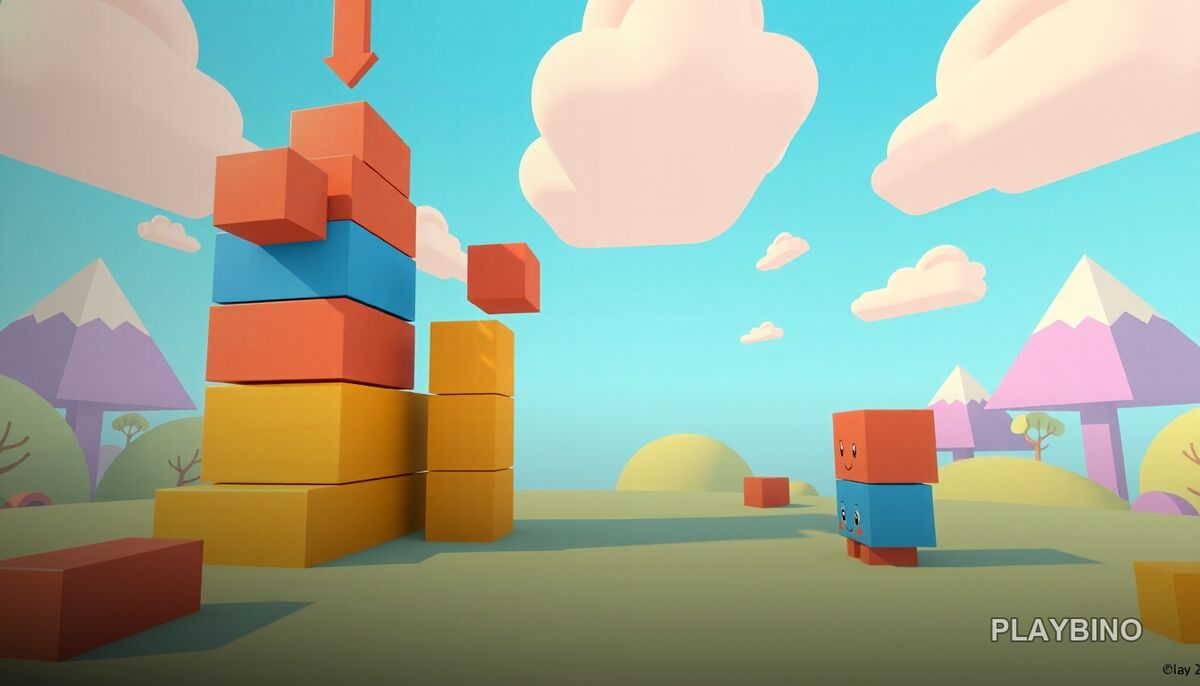
Most browser puzzles operate on a flat grid. Blocks 3D breaks that convention by placing the challenge inside a three-dimensional space, where depth, angle, and camera rotation all factor into every decision. Each block on the field carries an arrow that tells you which direction it will fly off when cleared. Your job is to remove every block before the timer runs out—but only blocks with an unobstructed path in their arrow's direction can actually leave the field.
The result is a logic puzzle that rewards spatial thinking over speed alone. You can play this 3D browser puzzle on PlayBino without any download or installation.
Reading the Arrows
The arrow system is the core mechanic. Every block shows a directional arrow—left, right, forward, backward, up, or down. Before tapping a block, you need to confirm that nothing is blocking its exit path in that direction. A block surrounded on its arrow side cannot move, so selecting it out of order wastes precious seconds and locks the board into a harder state.
Path Visualization
This is where spatial awareness becomes critical. When you look at the field straight on, some paths appear blocked that are actually open, and vice versa. Mentally tracing the line from each block outward in its arrow direction—and checking whether any other block sits in that corridor—is the fundamental skill the game builds over time.
Order of Removal
Clearing blocks in the wrong sequence can box in blocks that were previously removable. The puzzle logic rewards players who look two or three moves ahead rather than clearing whatever seems easiest first. Think of it like a spatial version of a sliding tile puzzle: the sequence matters as much as the individual moves.
Camera Rotation as a Solving Tool
Rotating the camera is not just a visual option—it is a problem-solving mechanic. A configuration that looks completely jammed from the front may reveal an obvious solution from the side or from above. The game actively encourages this by designing levels where at least one key path is hidden from the default viewing angle.
Developing the habit of rotating the camera before committing to a move separates faster solvers from players who get stuck. A quick spin around the field often reveals which block needs to go first, and that single insight can unlock a chain of clean removals.
Timer Pressure and Level Progression
The ticking clock adds a layer of tension that pure logic puzzles often lack. Early levels give enough time to rotate, plan, and execute carefully. As arrangements grow more complex, the margin for hesitation shrinks. The timer does not punish thoughtful play—it punishes indecision and repeated re-scanning of the same angles without committing.
- Each level introduces a new block arrangement, so no two puzzles feel identical.
- The three-dimensional layout increases in complexity as levels progress.
- Blocks that appear clearable may be trapped behind others at different depths.
- A single well-chosen rotation can reveal the entire solution sequence.
Strategy for Tighter Levels
When the clock pressure increases, a few habits help maintain control. Start by identifying any block that has a completely open path right now—those are your free moves. Then look for blocks whose paths will open once a neighbor is removed. Building a mental chain from free blocks outward is more reliable than scanning randomly under pressure.
Avoid fixating on one section of the field. Tunnel vision on a cluster of blocked blocks wastes time when open paths exist elsewhere. Clearing peripheral blocks first often frees up the center faster than attacking the densest area directly.
A Different Kind of Puzzle to Try Next
If the spatial and timed format of Blocks 3D appeals to you, logic puzzles with different mechanics are worth exploring. Rescue Kitty Puzzle offers another browser-based logic challenge with its own distinct puzzle structure, and comparing the two shows how differently constraint-based puzzles can be designed. Both reward careful thinking over reflexes, but the approaches they demand are quite different.