The Memory Matrix: Bridge Puzzles That Test Your Short-Term Memory
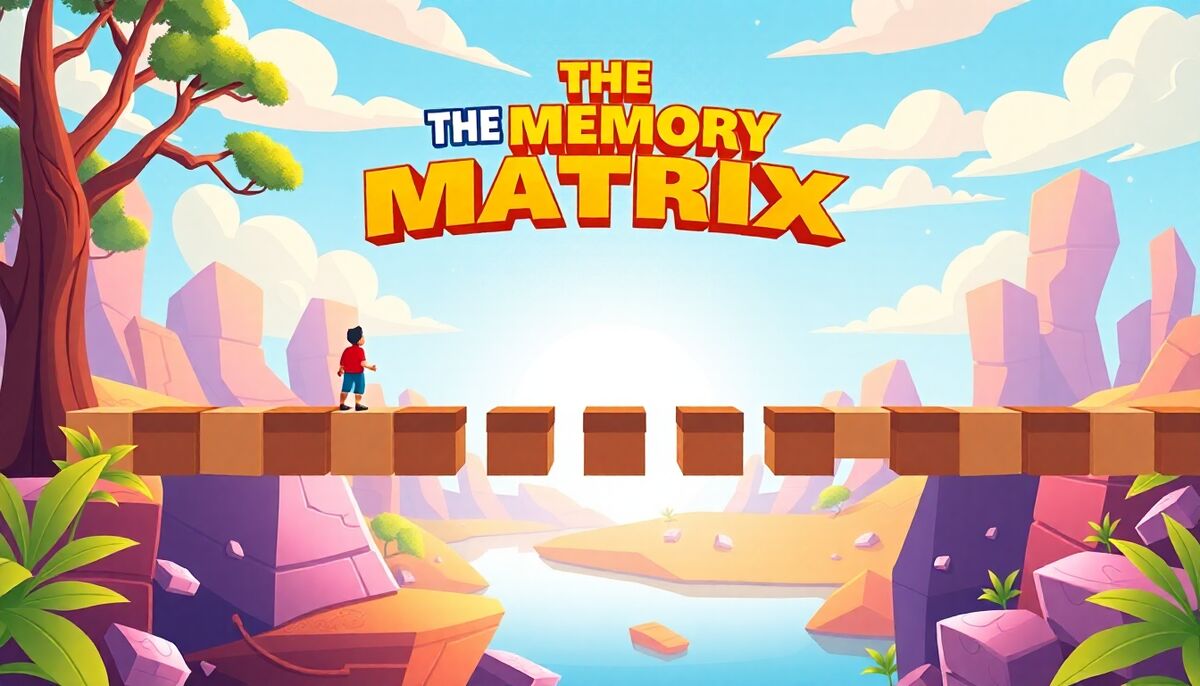
What The Memory Matrix Is About
You play as Rai, a character on a mission to rescue a kidnapped friend named Rina. The path forward runs across bridges, but the crossing is never straightforward. Each level briefly illuminates a sequence of safe blocks, then hides them completely, leaving you to reconstruct the path from memory alone. One wrong step sends Rai into the river, and you start the level again. The Memory Matrix strips the puzzle genre down to its core: observe, remember, act.
How the Bridge Mechanic Works
At the start of each level, the safe bridge blocks light up for a few seconds. The sequence can be short and linear early on, but it grows more complex as you advance. Once the blocks go dark, you must select them in the correct order to build a passable crossing. There is no guessing tool, no second hint. The game relies entirely on what your brain retained during that brief window.
Timing the Observation Phase
The observation window is short enough to create real pressure. Scanning the blocks systematically rather than randomly tends to help. Some players mentally group blocks into clusters or trace a visual path during the flash phase. The game does not penalize you for taking time to select blocks after the flash ends, so deliberate choices matter more than speed during the selection phase.
What Happens When You Fail
Falling into the river resets the current level rather than ending the game entirely. This keeps the experience from feeling punishing, but repeated failures on the same pattern do build tension. Each retry is also a chance to reinforce the correct sequence in memory, which means failure often teaches more than an easy pass.
Difficulty Curve and Level Progression
Early levels introduce short, simple patterns that most players can retain without much effort. The purpose is to build familiarity with the mechanic rather than challenge memory directly. As levels progress, sequences become longer, less predictable, and arranged in shapes that are harder to trace visually. The gradual increase in complexity feels deliberate rather than arbitrary, making each new level a meaningful step up rather than a sudden wall.
Strategy for Harder Levels
- Focus on the start and end points of the sequence first, then fill in the middle.
- Assign a mental label to each block position, such as left edge, center, far right.
- Avoid trying to memorize every block simultaneously; break the pattern into two or three smaller groups.
- After a failed attempt, pay attention to which part of the sequence you got wrong rather than restarting observation from scratch.
- Stay calm during the flash phase. Anxiety shortens effective recall time.
Who This Game Suits
The Memory Matrix works well for anyone who enjoys brain and logic puzzles that demand concentration rather than quick reflexes. The one-player format keeps the focus inward. There are no enemies, no timers counting down during selection, and no distracting visual noise. The minimalist design is a deliberate choice that keeps attention on the mental task. Players who enjoy pattern recognition, memory training, or quiet puzzle challenges will find the format satisfying.
If you also enjoy brain-focused challenges that push your thinking in a different direction, another logic-based puzzle worth exploring is Math Challenge Online, which trades memory patterns for numerical reasoning.
Why the Format Holds Up
Most memory puzzle games either rely on matching pairs or repeat the same mechanic without variation. The Memory Matrix ties memory directly to consequence: a wrong block means a fall, and the stakes feel real even in a browser game. The story framing around Rai and Rina gives the progression a sense of purpose, which is rare for a puzzle game of this type. PlayBino hosts the game in a clean browser environment that keeps load times low and keeps you focused on the puzzle rather than the platform.