Snake And Apple: 99 Levels of Spatial Puzzle Thinking
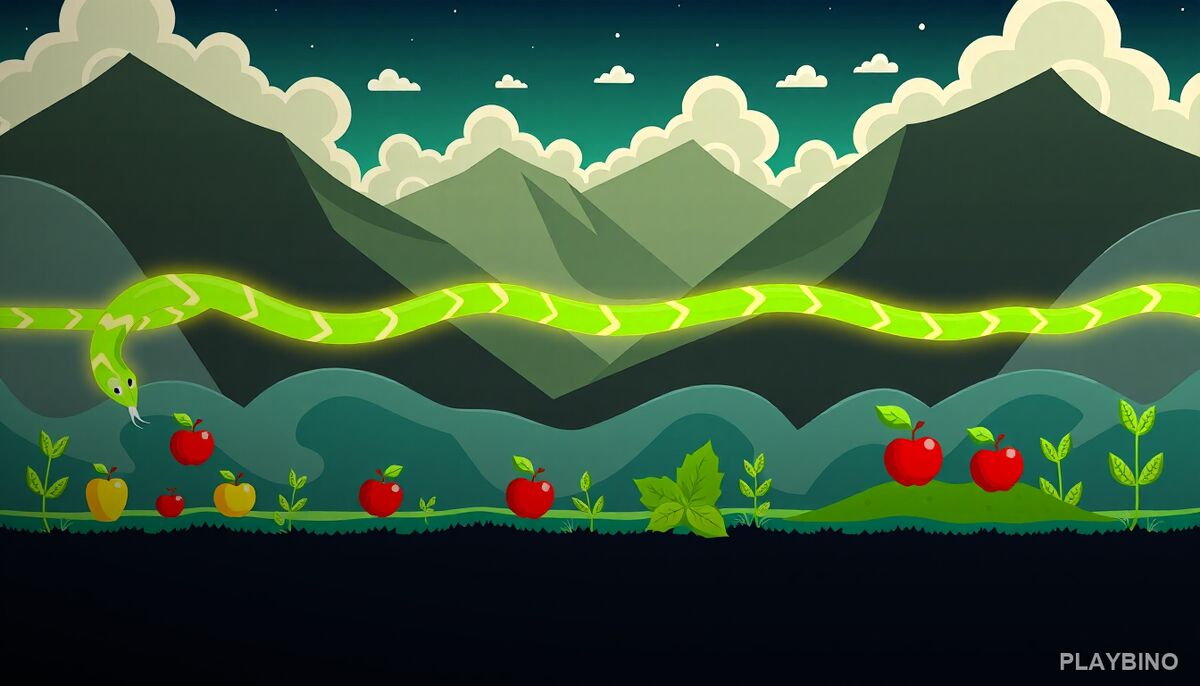
What Kind of Game Is This?
Snake And Apple takes a familiar concept and reshapes it into something closer to a logic puzzle than an arcade reflex game. Instead of surviving as long as possible on an endless grid, you work through 99 hand-crafted levels, each with a specific layout, a set number of apples, and a finish point you need to reach. Play it directly in your browser and the difference from classic snake becomes clear within the first few stages.
The core loop is simple: collect every apple on the board, grow longer with each one, then exit through the goal. What makes it genuinely challenging is that the snake's body stays on the board as a physical obstacle. Every apple you eat narrows the space available for future movement.
How the Puzzle Mechanics Work
Each level is a contained grid with walls, corridors, and apple placements that have been deliberately designed to create a spatial problem. You are not reacting to random events — you are solving a layout. The question is always the same: in what order should the apples be collected so the growing tail does not block the only path to the exit?
Planning Ahead
Early levels give you room to experiment. The corridors are wide enough that a wrong turn can often be corrected. By the midpoint of the 99 levels, that margin disappears. Tight passages mean that eating an apple in the wrong sequence can leave your tail cutting off the only viable route forward. The game rewards players who mentally trace two or three moves ahead before committing.
The Role of the Tail
Unlike reflex-based snake games, the tail here is a puzzle element rather than a hazard to outrun. It shrinks as you move — older segments eventually disappear — but in dense layouts, the tail lingers long enough to block corridors you need to pass through again. Learning to use tail decay as part of your solution is one of the more satisfying mechanics the game introduces in later stages.
Level Design and Difficulty Curve
The 99-level structure gives the game a clear progression arc. The first dozen or so levels introduce the basic idea without pressure. Then the layouts start adding bends, dead ends, and apple placements that force you to approach the board from a specific direction. Around the halfway point, some levels require a near-complete plan before the first move.
The difficulty never feels arbitrary. Each level has a logical solution, and when you find it, the path threads together cleanly. That sense of a puzzle clicking into place is the main reward the game offers.
Controls and Visual Style
Movement is handled with arrow keys or swipe gestures, keeping input simple and responsive. The clean visual design removes any distraction from the spatial thinking. There are no timers, no score multipliers, and no pressure beyond the puzzle itself. This makes Snake And Apple feel more like a brain teaser app than a competitive arcade game, which suits the logic and puzzle tags it carries well.
Players who enjoy maze-style pathfinding challenges may also want to look at Maze Madness Adventure, another browser game built around navigation and spatial problem-solving.
Who Plays This Well
The game suits anyone who prefers thinking over twitching. If you find satisfaction in working out a route before executing it, the 99-level structure gives you a long runway of increasingly complex problems to work through. Casual players can progress steadily through the earlier stages, while the later levels offer a real challenge for those who want to push further.
- 99 levels with hand-designed layouts
- Spatial puzzle logic rather than reflex-based gameplay
- Tail mechanics that become part of the solution
- Clean controls via keyboard or touch
- No timers — pure planning focus
PlayBino hosts the full run of all 99 levels, so progress is accessible any time without a download. If you get stuck on a particularly tight stage, stepping away and returning with fresh eyes often reveals the sequence you missed.