Summer Mazes: Puzzle Paths and Spatial Logic
What Kind of Game Is This?
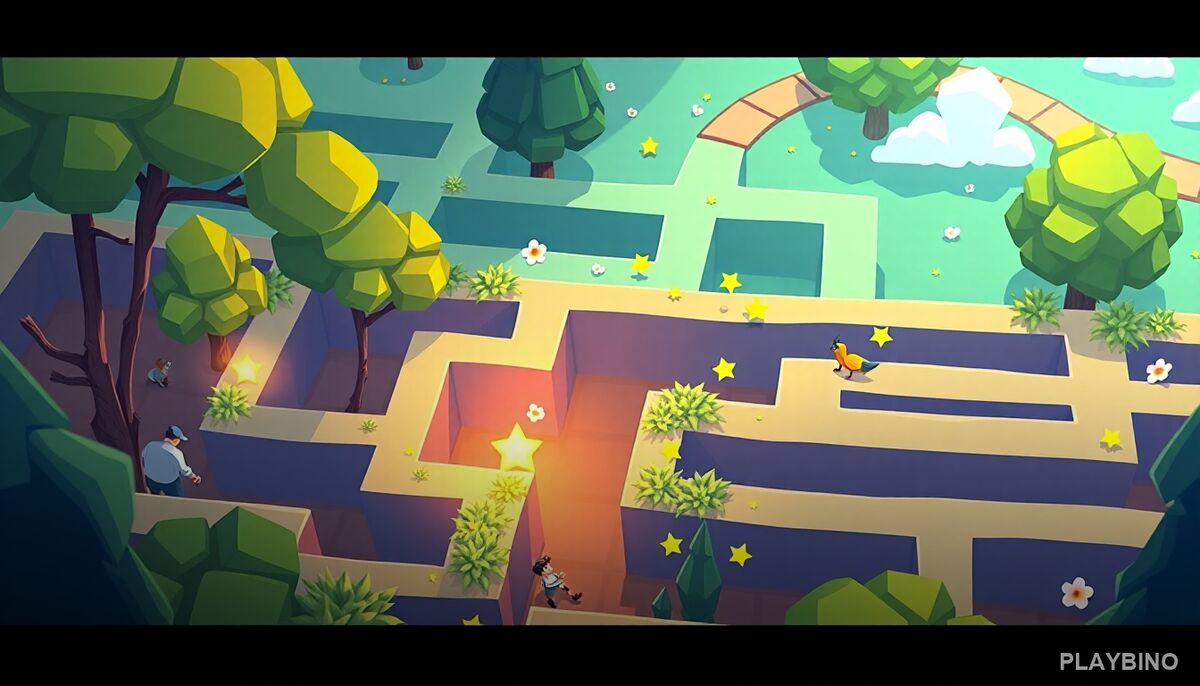
Summer Mazes is a single-player browser puzzle built around one core idea: find the exit. Each level presents a different maze layout filled with branching corridors, sharp turns, and dead ends. The challenge is purely spatial — no timers pushing you to rush, no enemies chasing you down. Just you, the path, and the question of which direction leads forward. The bright seasonal color palette keeps the mood light, making it easy to pick up and play without any pressure.
Navigation and Spatial Reasoning
The central mechanic is path-finding. Players move through winding corridors, scanning for routes that open up rather than loop back. Early levels are forgiving, with relatively open layouts that let you get a feel for how the mazes are constructed. As you advance, the designs grow denser and more deliberate, with passages that seem promising but dead-end just a few turns in.
Reading the Layout
One of the most useful habits to develop is pausing before committing to a direction. Scanning a few steps ahead — especially at intersections — helps avoid backtracking. The mazes reward observation over speed. If you treat each junction as a small decision point rather than just moving on instinct, you'll find the exit more efficiently.
Dealing With Dead Ends
Dead ends are placed deliberately. Some corridors look like main routes but terminate quickly, while narrower-looking passages sometimes open into larger sections. Learning to read visual cues in the layout — width of corridors, how paths curve — becomes a useful skill across multiple levels.
How the Difficulty Scales
The progression in Summer Mazes is gradual rather than sudden. Early puzzles introduce the basic structure without overwhelming new players. Mid-game levels start layering more complexity into the corridor design, requiring more careful planning and the occasional backtrack. Later mazes demand a more methodical approach — sometimes mentally mapping sections before moving through them. Try the full challenge in your browser to see how the difficulty curve feels across the full set of levels.
The Logic Behind the Puzzles
Despite the relaxed visual theme, the puzzle logic here is genuine. Each maze is a spatial reasoning exercise. You're not solving equations or matching symbols — you're building a mental model of a space and navigating it accurately. This makes Summer Mazes a solid brain workout that doesn't feel like one, which is part of what keeps it engaging for casual players.
- Path-finding through multi-corridor layouts
- Gradually increasing maze complexity
- No time pressure — focus stays on logic and observation
- Bright summer visuals that keep the tone relaxed
- Satisfying level completion with clear progression
Strategy for Harder Levels
When layouts get more intricate, a few approaches help. Treating the maze as a series of zones — rather than one continuous path — makes it easier to mentally track where you've already been. Prioritizing unexplored branches over revisiting known dead ends saves time. Some players find it useful to work backward from the exit when they can see it, identifying which corridor connects to it and tracing back from there.
Maze Controlling on PlayBino takes a different mechanical angle on the genre — if you want to see how maze navigation shifts when control mechanics change, that game offers a distinct take worth exploring.
Who This Game Suits
Summer Mazes works well for players who enjoy quiet, logic-focused puzzles without competitive pressure. The single-player format and relaxed pacing make it a good fit for short sessions or longer play depending on how many levels you tackle at once. The spatial reasoning element gives it some genuine mental engagement, while the cheerful presentation ensures it never feels heavy. Anyone who likes brain puzzles, logic challenges, or simply unwinding with a low-stakes game will find it a comfortable fit.